TL;DR
- KV cache moved into the control plane: vLLM, SGLang, TensorRT-LLM, Mooncake, LMDeploy, and Ray all pushed cache, routing, and disaggregated serving work, with vLLM showing the widest cross-backend activity.1
- Apple-local inference matured fast: Apple Core AI, MLX, MLX-LM, MLX Swift, Rapid-MLX, Uzu, Ollama, and vllm-mlx all improved Apple Silicon serving, model loading, cache safety, and multimodal support, led by Apple Core AI Models.2
- Local runtimes chased MoE and decision models: llama.cpp, Ollama, exllamav3, oMLX, Rapid-MLX, and Uzu all worked on MoE caching, speculative decode, decision scoring, and long-context memory behavior, with Ollama turning decision models into a first-class path.3
- Edge stacks stayed busy: LiteRT, MediaPipe, ONNX Runtime, ExecuTorch, ncnn, MNN, Qualcomm GenieX, FluidAudio, and sherpa-onnx all hardened model export, runtime safety, and device-specific acceleration, with ONNX Runtime shipping the biggest cross-platform release.4
- Audio and realtime inference surged: SGLang-Omni, Open WebUI, FluidAudio, mlx-audio, WhisperKit, and LocalAI all pushed voice, TTS, ASR, realtime calls, and streaming behavior, with SGLang-Omni carrying the broadest audio-model expansion.5
This Week in Inference
The supplied market scan did not confirm new external model launches, hardware announcements, funding events, or industry partnerships for the week, so the public signal was quiet. The repo signal was not quiet: inference teams spent the week integrating Qwen, Gemma, DeepSeek, GLM, MiniCPM, MiniMax, Ling, Fish Audio Drama, Paradee, and other fast-moving families into serving engines, local runners, Apple stacks, and edge frameworks, with major model-support work visible in Hugging Face Transformers, SGLang, and MLC WebLLM.6
The main technique pattern was cache and memory management. vLLM hardened KV offload, NIXL, Mooncake, speculative decode, and ROCm paths, while SGLang worked on prefix/cache scheduling, disaggregated serving, EAGLE paths, and Rust frontend parity vLLM.1 TensorRT-LLM moved KV-cache V2 into the default path and expanded Mooncake, KV lending, CUDA IPC, and disaggregated serving support TensorRT-LLM.9 Ray, LMDeploy, Mooncake, Dynamo, and LightLLM all showed the same direction: schedulers now own cache semantics, routing, replay, admission, and failure behavior Ray.10
Hardware work stayed fragmented by target. NVIDIA projects pushed Blackwell, Rubin, SM120, CUDA, TensorRT, CUTLASS, and TensorRT-LLM paths TensorRT-LLM.9 ROCm projects pushed AITER kernels, ATOM serving, Windows support, MoE, MLA, and AMDMIGraphX graph/runtime work AITER.11 Apple-focused projects pushed MLX, Core AI, Swift, local agents, and Mac app runtimes MLX.12 Edge teams pushed WebGPU, LiteRT, MediaPipe, ONNX Runtime, ncnn, ExecuTorch, Qualcomm GenieX, and FluidAudio deployment paths LiteRT.13
Top Stories
vLLM and SGLang turn cache correctness into the center of serving
vLLM spent the week on ROCm/AITER support, MRv2 and speculative decode, quantization, NIXL, Mooncake, KV offload, and serving correctness across the core engine vLLM.1 SGLang pushed cache-aware scheduling, Rust API parity, routing, DeepSeek and GLM paths, and EAGLE cache behavior across text, VLM, and diffusion workloads SGLang.7 Together, the two projects show where open serving is headed: cache state, request routing, and accelerator-specific kernels now move together.
Apple-local inference gets a full-stack week
Apple shipped a stable Core AI Models line while MLX fixed runtime hazards, quantization paths, SDPA behavior, and Python support Apple Core AI Models.2 MLX-LM and MLX Swift-LM added model-family support, lazy multimodal loading, KV and prompt-cache fixes, and Swift-side embedders and VLM work MLX Swift LM.14 Outside Apple, Rapid-MLX, Uzu, Ollama, Osaurus, vllm-mlx, and oMLX all hardened Mac-native model serving, which makes Apple Silicon one of the most active local inference targets this week Rapid-MLX.15
Ollama and llama.cpp push local inference beyond chat
Ollama moved decision models onto native llama.cpp and SystemOne-style paths, added CLI decision flows, and tied that work to MLX and llama.cpp updates Ollama.3 llama.cpp pushed MoE caching, multi-GPU behavior, MiniCPM-V, Prism Bonsai, Vulkan, OpenCL, CUDA, HIP, SYCL, Hexagon, server, tokenizer, and graph hardening llama.cpp.16 The local runtime stack is no longer a single-user chat loop; it is becoming a model router with scoring, multimodal inputs, speculative execution, and mixed CPU/GPU memory policy.
ONNX Runtime, LiteRT, and ExecuTorch raise the edge floor
ONNX Runtime shipped a major release with model package APIs, CUDA plugin work, WebGPU expansion, QMoE paths, and mobile/server deployment hardening ONNX Runtime.4 Google’s LiteRT, LiteRT-LM, MediaPipe, XNNPACK, samples, and Gallery work moved together around model export, WebGPU, Qwen/Gemma metadata, Tasks APIs, and runtime acceleration LiteRT.13 ExecuTorch added native GGUF and ggml support, Vulkan work, Qualcomm and Arm paths, portable kernel fixes, MLX serving, prefix-cache behavior, and a release tracker ExecuTorch.17
Audio inference becomes a first-class workload
SGLang-Omni added native diarization, Fish Audio Drama support, TTS and ASR paths, full-duplex bench support, Apple-native runtime work, and realtime audio serving polish SGLang-Omni.5 FluidAudio shipped Paradee-8M Core ML support, Kokoro ANE work, ASR speedups, Cohere Transcribe fixes, diarization changes, and tvOS and visionOS packaging work FluidAudio.18 Open WebUI, LocalAI, mlx-audio, WhisperKit, sherpa-onnx, and Qualcomm GenieX also moved voice, TTS, ASR, and realtime behavior, which makes audio one of the week’s clearest cross-stack themes Open WebUI.19
Deeper Dive
Everything below is for readers who want the full picture. Feel free to scroll.
Code Changes by Category
Cloud & Datacenter Serving
vLLM, SGLang, TensorRT-LLM, Ray, Dynamo, LightLLM, FlashInfer, LMDeploy, DeepSpeed, and Triton all worked on serving reliability, cache movement, or accelerator integration vLLM.1 TensorRT-LLM made KV-cache V2 the default path, expanded Mooncake and KV lending, and worked through distributed-serving and runtime sleep support TensorRT-LLM.9 Ray upgraded its LLM stack, fixed fractional-GPU vLLM serving, and added benchmark metrics for vLLM batch workloads Ray.10
SGLang had one of the heaviest serving weeks, with Rust frontend parity, routing, prefix/cache behavior, DeepSeek work, GLM and Qwen support, and diffusion serving improvements SGLang.7 LightLLM integrated XGrammar into normal sampling, added Qwen DFlash2 paths, hardened stop handling, and improved cache-aware PD routing LightLLM.20 FlashInfer pushed MoE, Blackwell/Rubin paths, quantized GEMM, MLA, TensorRT-LLM integration, and Cake attention work FlashInfer.21
Local LLM Runtimes
llama.cpp drove the highest local-runtime volume, with MoE caching, multi-GPU improvements, Vulkan and OpenCL fixes, MiniCPM-V and Prism Bonsai support, SYCL and CUDA work, server fixes, and many prerelease drops llama.cpp.16 Ollama aligned with llama.cpp for native decision models, added ollama run decision flows, and worked through MLX, launcher, cloud, and manifest performance fixes Ollama.3 exllamav3 focused on CPU-MoE offload, recurrent-state memory, DFlash2 tensor parallelism, ROCm fixes, and speculative correctness exllamav3.22
LocalAI added reasoning controls, realtime voice fixes, audio generation, diagnostics, Qdrant storage, PII redaction, MCP OAuth, and gallery/backend updates LocalAI.23 oMLX shipped scheduler work for memory pressure, continuous batching, long-context Qwen and GLM acceleration, decision APIs, Splash serving, quantization, and UI polish oMLX.24 llamafile added an experimental Agentfile CLI agent layer on top of agent.cpp with opt-in tools llamafile.25
Apple Silicon & MLX Ecosystem
Apple released Core AI Models and MLX updates while Core AI Optimization improved palettization and Python support Core AI Models.2 MLX fixed Metal synchronization, quantization, NAX matmul, convolution, SDPA, distributed, serialization, and extension build support MLX.12 MLX-LM and MLX Swift-LM added unconverted model support, MiniMax fixes, Qwen support, EmbeddingGemma, lazy loading, compiled VLM decode, and cache correctness MLX LM.26
Rapid-MLX shipped Local Search behind defaults, hardened server startup, improved Qwen, GDN, MTP, PFlash, multimodal, and agent integrations, and released both CLI/server and Mac app builds Rapid-MLX.15 Uzu shipped Mac app fixes, profiling changes, prefill and kernel speedups, and QTIP layout work in sync with Lalamo Uzu.27 Osaurus shipped multiple Mac app releases with local inference, agent tools, provider compatibility, phone workflows, and UI stability fixes Osaurus.28
Mobile & Edge Frameworks
Google pushed LiteRT, LiteRT-LM, MediaPipe, XNNPACK, litert-torch, samples, Gallery, CLI, and quantizer work around Qwen, Gemma, WebGPU, model export, Tasks APIs, and edge demos LiteRT.13 Microsoft shipped ONNX Runtime with CUDA plugin releases, WebGPU work, model-package APIs, QMoE kernels, and Foundry Local alignment ONNX Runtime.4 ExecuTorch added GGUF and ggml support, Vulkan paths, Qualcomm and Arm backend improvements, prefix-cache serving, MLX serving, and portable kernel fixes ExecuTorch.17
Tencent ncnn pushed RISC-V INT8 convolution, Winograd, pnnx conversion fixes, RoPE correctness, Vulkan staging, Python binding lifetime fixes, and CI updates ncnn.29 Alibaba MNN worked on converter correctness, Metal and Vulkan fixes, ARM FP16 RoPE, LLM export, and mobile/backend parity MNN.30 Qualcomm AI Hub and GenieX expanded deployable content, LLM evaluation, decision serving, QAIRT integration, input embeddings, and app releases GenieX.31
Compilers, Runtimes & Graph Engines
TVM moved deeper into TIRx, FFI, runtime ownership, codegen cleanup, WebGPU attention, and legacy backend retirement TVM.32 OpenXLA worked on GPU collectives, all-to-all, Triton and TensorIR fusion, IFRT/PJRT APIs, StableHLO, Shardy, CPU correctness, and vendor backend support OpenXLA.33 Triton Lang advanced NVIDIA lowering, CUDA toolchains, AMD scheduling, frontend semantics, JIT/runtime contracts, FPSan behavior, and FP8/rounding work Triton.34
TensorFlow mirrored much of the XLA direction while adding security and runtime hardening across TensorFlow core and TFLite Micro TensorFlow.35 JAX focused on reverse-mode AD, ref/state correctness, special functions, Pallas and Mosaic, sharding, ROCm quantizer paths, and IFRT Proxy backend support JAX.36 Modular moved MAX and Mojo nightlies, model kernels, KV Rust plumbing, compiler ABI refactors, and serving observability Modular.37
Models, Quantization & Optimization
Hugging Face added Ling Flash, Kolibri, LFM2 GGUF loading, Molmo2, PP-DocLayout, SANA-WM video diffusion, LoRA and adapter fixes, OpenVINO export work, and quantization/export paths across Transformers, Diffusers, and Optimum Intel Transformers.6 FlashAttention shipped maintenance and FA4 beta releases while fixing FA2 overflow and SM120 num_splits behavior FlashAttention.38 ROCm AITER, ATOM, and AMDMIGraphX moved AMD LLM inference forward through Windows support, MoE, MLA, paged attention, all-reduce, DeepSeek and Qwen serving paths, and graph-runtime work AITER.11
Intel Neural Compressor removed PT2E quantization support and surfaced an asymmetric INT8 recovery bug with a proposed widening fix Neural Compressor.39 WebLLM added Gemma browser inference records, runtime upgrades, library rebuilds, and Phi vision prefill capacity WebLLM.8 CTranslate2 added UMT5 support, ROCm Windows fixes, Python runtime safety, and sanitizer coverage CTranslate2.40
Other Notable Changes
Open WebUI shipped Realtime voice calls, external apps in channels, MinerU support, socket reconnect fixes, RAG citation work, admin safeguards, and localization Open WebUI.19 LiteLLM added realtime OpenAI-compatible WebSocket proxy routes, video generation support, per-model team budgets, MCP state handling, core packaging changes, and observability controls LiteLLM.41 BentoML had no merged code, but saw targeted PRs for tensor serialization, readiness timeouts, async uploads, image build state, and model export paths BentoML.42
Community Pulse
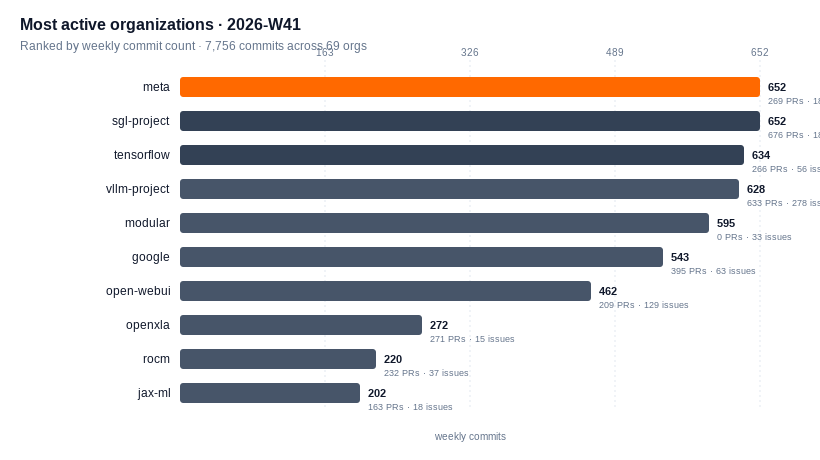
The hottest communities by visible activity were Open WebUI, vLLM, SGLang, TensorFlow, Meta, Google AI Edge, ggml, ROCm, and Modular Open WebUI.19 Stars also clustered around user-facing tools, with Open WebUI, Hugging Face, llama.cpp, Ollama, vLLM, Cactus Needle, and SGLang all showing strong growth llama.cpp.16
Several issue threads had direct production impact. Open WebUI users reported a reconnect loop that could produce high CPU and large Postgres egress before maintainers fixed socket behavior Open WebUI issue.43 Triton Inference Server users reported severe Prometheus latency-summary overhead on a CPU identity model Triton issue.44 UbiquitousLearning received a path traversal report in its mobile model conversion path mllm issue.45
Community Debates
llama.cpp maintainers closed Blackwell NVFP4 quantization work over scale and quality concerns, while CUDA MoE expert prefetch closed after multi-GPU wrong-output questions and mmap/page-cache concerns llama.cpp NVFP4.46 The pattern was clear: performance patches need correctness evidence across backends before landing in a runtime used by many downstream wrappers.
MLX maintainers closed quantized SDPA because decode-only kernels did not cover the broader KV-cache quantization design space, and they redirected command-buffer limit tuning toward a general dynamic config API MLX quantized SDPA.47 The MLX debate mirrors the broader Apple-local stack: maintainers want system-level interfaces, not one-off switches.
SGLang closed multiple cache and disaggregation proposals, including HiCache buffer-only mode, HiSparse MTP draft-zone work, and LMCache KV-event paths, because correctness and ownership rules were not settled SGLang HiCache.48 The project is moving fast, but the maintainers keep pushing cache changes toward designs that survive multi-DP, multimodal, and disaggregated serving.
TensorFlow and TFLite Micro maintainers rejected several speculative validation and security PRs when proposals added hot-path cost, lacked concrete failing cases, or did not match the project’s security process TensorFlow batch norm.49 That debate matters because edge inference code often handles untrusted model artifacts.
Modular closed large outside model-architecture PRs because maintainers said they are accepting bug fixes rather than broad external model implementations in that area Modular model PR.50 The signal is useful for contributors: compiler and runtime projects may welcome narrow fixes while keeping model surface area tightly curated.
Worth Watching
- Disaggregated prefill/decode is spreading: vLLM, SGLang, TensorRT-LLM, Ray, Dynamo, ATOM, Mooncake, LMDeploy, and LightLLM all touched cache transfer, KV routing, prefill/decode separation, or cache admission this week Mooncake.51
- Apple inference is becoming a second full-stack market: Core AI, MLX, Rapid-MLX, Uzu, Osaurus, Ollama, vllm-mlx, and FluidAudio all moved in the same week MLX.12
- Audio is no longer peripheral: SGLang-Omni, FluidAudio, mlx-audio, WhisperKit, LocalAI, sherpa-onnx, and Open WebUI all shipped or reviewed meaningful audio paths SGLang-Omni.5
- Browser and WebGPU inference keep getting more serious: WebLLM rebuilt its WebGPU library catalog while ONNX Runtime and Google’s edge stack moved WebGPU execution and samples forward WebLLM.8
- Security reports are moving closer to model artifacts: FastChat, mllm, TensorFlow Serving, ONNX, LiteRT, and LocalAI all had security or trust-boundary threads around model loading, adapters, file paths, or service APIs FastChat.52
Major Releases
ai-dynamo shipped five experimental model-specific Dynamo snapshots, centered on Motif, GLM Flash, MiniMax, DeepSeek Flash, and Kimi serving builds across vLLM and SGLang backends. The dominant theme was release preparation and artifact/model-image hardening for distributed inference. Latest release.53
AMD Ryzen AI, FastFlowLM, GAIA, and Lemonade shipped FastFlowLM v1.0.8, multiple GAIA v0.25.0 release candidates, Lemonade candidate-v2026.43.0, and Lemonade v2026.42.1. The focus was local AI productization on Ryzen AI, including Gemma 4 hooks, MiniCPM-V support, server ownership, telemetry, and image-editing improvements. FastFlowLM release.54
Apache TVM FFI shipped tvm-ffi v0.1.15-rc0, a prerelease focused on ORC JIT, typed references, Rust interop, and release-candidate packaging. The broader Apache TVM work centered on TIRx, runtime ownership, and FFI modernization..55
Apple shipped coreai-models v1.0.0 and mlx v0.32.4. Core AI Models reached its first stable release, while MLX added SDPA VJP, Python support, fixed-size unique, and other runtime fixes. Core AI Models release.56
Argmax shipped argmax-oss-swift v1.1.1, focused on WhisperKit crash hardening, TTS chunking fixes, background download reliability, and Hugging Face token behavior changes. The release strengthens on-device speech reliability for Apple apps..57
BerriAI shipped a large LiteLLM release train from v1.101.6 through v1.107.0-dev.1, with the most visible theme being Docker image signing and cosign verification. The code work underneath expanded realtime proxying, video generation, budgets, MCP session behavior, and observability. Latest release.58
Blaizzy shipped mlx-audio v0.5.9 and mlx-vlm v0.7.8. The releases expanded MLX audio and multimodal support, including Fish/Irodori TTS, Qwen-related fixes, Kolibri, EmbeddingGemma, RF-DETR, and Qwen3.5 prefill paths. mlx-vlm release.59
Dao-AILab shipped FlashAttention v2.8.3.post2 and fa4-v4.0.0.beta35. The releases fixed FA2 backward overflow and SM120 FA4 automatic split behavior while continuing FA4/CuTe stabilization. FA4 release.60
FlashInfer shipped v0.7.1 and v0.7.2rc3. The stable release emphasized quantized expert-parallel MoE, Kimi speculative verification, Blackwell cuDNN linear attention, DeepSeek sparse MLA, and NVFP4 recipes, while the prerelease hardened Cake DSv4 paths. Stable release.61
FluidInference shipped FluidAudio v0.17.7, adding a beta Paradee-8M Core ML backend, int8 and fp32 builds, and Kokoro frontend reuse. The surrounding work improved ASR speed, Kokoro ANE support, Mandarin routing, diarization, and Apple platform packaging..62
ggml shipped a dense llama.cpp prerelease train from b11480 through b11624, covering MoE caching, multi-GPU MoE cache, MiniCPM-V 4.7, Prism Bonsai 2, backend fixes, server hardening, and platform updates. whisper.cpp had no release, but it received portability and CLI fixes. Latest llama.cpp release.63
Google shipped ai-edge-quantizer v0.10.0 and mediapipe v1.1.1. The quantizer release introduced an experimental OSCAR note and migration path toward LiteRT Quantizer, while MediaPipe added Flutter/C API work, GPU interactive segmentation fixes, and LiteRT migration. MediaPipe release.64
jundot shipped oMLX v0.7.1.dev1, a development release covering decision models, concurrent prompt prefill, model-family speedups, and a refreshed web UI. The week’s code also focused on memory-pressure scheduling, long-context Qwen and GLM, and quantization..65
Microsoft shipped ONNX Runtime v1.31.0 plus CUDA plugin EP v0.2.0 and v0.3.0. The releases focused on model-package APIs, EPContext, CUDA/WebGPU updates, INT2 and mixed-width QMoE, paged KV caches, speculative decoding, and continuous-batching attention. ONNX Runtime release.66
MLC AI shipped WebLLM v0.2.86. The release added Gemma 4 E2B instruction-tuned WebGPU records, updated the web runtime, rebuilt WebGPU libraries, and moved Phi-3.5 vision to larger prefill libraries..67
NVIDIA shipped TensorRT v11.4 and TensorRT-LLM v1.4.0rc0. TensorRT focused on parser refit observers and C++20 plugin updates, while TensorRT-LLM’s prerelease exposed known TP streaming, SM120, and NCCL edge cases around its next runtime line. TensorRT-LLM release.68
Ollama shipped v0.40.2, v0.40.3, v0.40.4, and v0.40.5-rc0. The release train moved decision models into native llama.cpp/SystemOne paths, added ollama run decision workflows, paused a costly model-upgrade path, and brought MLX CUDA custom kernels into the candidate line. Latest release.69
Open WebUI shipped v0.12.0, v0.12.1, and v0.12.2. The line introduced Realtime voice calls, external apps in channels, and MinerU 4.x self-hosted support, while follow-up work fixed socket reconnect behavior and RAG citations. Latest release.70
OpenNMT shipped CTranslate2 v4.8.3. The release added UMT5 support, Transformer per-layer relative attention bias support, Windows ROCm fixes, file-like model loading crash fixes, and release-pipeline hardening..71
osaurus-ai shipped 0.25.20, 0.25.21, and 0.25.22. The releases improved local inference speed, vmlx-swift integration, MiniCPM-V and DSpark behavior, compute-weight admission, screenshot scrubber safety, Liquid/LFM runtime support, and agent-tool reliability. Latest release.72
Qualcomm shipped ai-hub-apps v0.39.1 and GenieX v0.8.1-rc.4. The AI Hub Apps release added an EasyOCR Ubuntu sample, while GenieX added logging controls, benchmark chat templates, QAIRT updates, and FastRPC mapping fixes. GenieX release.73
Rapid-MLX shipped v0.16.0, rapid-mac-v0.16.0, v0.16.1, and rapid-mac-v0.16.1. The releases expanded multimodal runtimes, decision workflows, accelerated profiles, server protections, image retention fixes, and installer/runtime diagnostics. Latest server release.74
ROCm shipped AITER v0.1.25 and ATOM v0.1.7. AITER’s release delivered ROCm/Python wheel builds for gfx targets, while ATOM shipped ROCm and torch wheel combinations for its serving stack. AITER release.75
RunanywhereAI shipped Wally v0.8.3 through v0.8.8 plus runanywhere-sdks cpp-desktop-v0.20.39. The week focused on decision models, image workflows, Windows updater safety, macOS bottles, auth, JSON metadata, automatic GPU placement, and desktop kits. Latest Wally release.76
SGLang shipped sglang-omni v0.1.8 and Voxt v1.16.0. The Omni release focused on audio, CI, Qwen3 Omni inputs, TTS latency, and NPU Docker publishing, while Voxt became the first SGLang-Omni voice-input app release for Apple Silicon. SGLang-Omni release.77
try-mirai shipped Uzu 0.6.2, 0.6.3, and 0.6.7. The release train tracked Qwen repetition fixes, server tool-calling fixes, Mac app work, profiling changes, kernel speedups, and packaged runtime updates. Latest release.78
turboderp-org shipped exllamav3 v1.6.1 and v1.6.2. The releases focused on flat recurrent VRAM overhead, recurrent draft models, DFlash sliding attention, CPU offload speed, DFlash2 tensor parallel support, ROCm fixes, and lower GDN/KDA/MLA VRAM overhead. Latest release.79
vLLM Project shipped vllm-gaudi v0.30.0. The release aligned the Gaudi plugin with upstream vLLM v0.30.0, Intel Gaudi Software v1.24.2, PyTorch 2.13, and upstream changes across MoE, MLA, KV cache, and quantization..80