TL;DR
- Serving engines chased low-bit MoE at scale: vLLM, SGLang, TensorRT-LLM, FlashInfer, and ROCm all pushed DeepSeek, GLM, Kimi, MiniMax, FP8, MXFP8, and NVFP4 serving paths.1
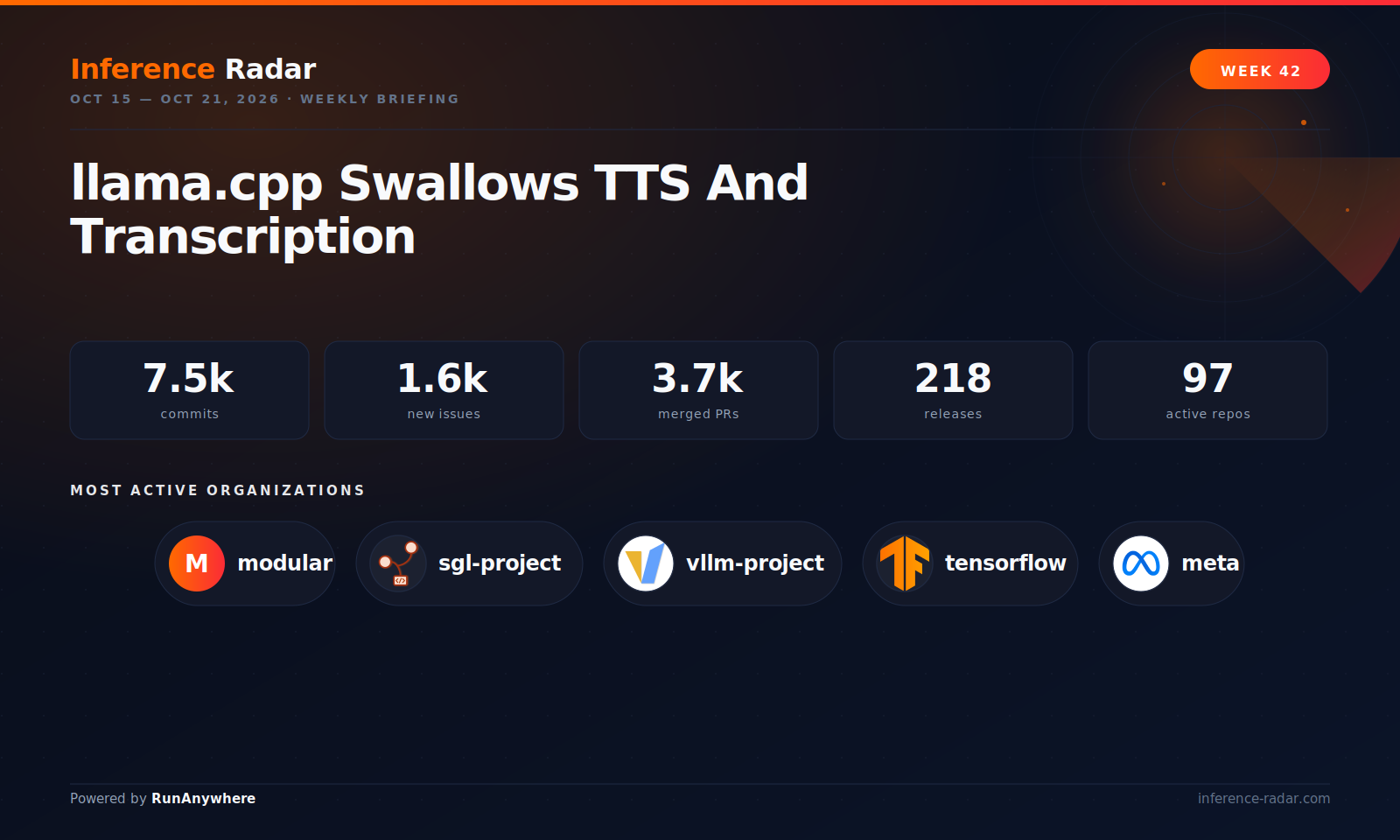
- Local runtimes became media servers: llama.cpp added model discovery, TTS, realtime transcription, and experimental peer access while Ollama shipped Flint, PPLX Decider, and Nemotron support.2
- Edge runtimes moved up-stack: Google LiteRT, Qualcomm GenieX, ExecuTorch, ncnn, MNN, OpenVINO, and sherpa-onnx all advanced LLM, VLM, TTS, ASR, and NPU packaging paths.3
- KV-cache became infrastructure: Mooncake, Dynamo, LightLLM, TensorRT-LLM, Ray, and SGLang all worked on KV transfer, prefix reuse, disaggregated prefill/decode, and cache observability.4
- Proxy security became a top concern: LiteLLM faced a severe supply-chain report while continuing provider, Responses API, privacy, and tracing work.5
This Week in Inference
The week’s model signal came less from external launch news and more from runtime enablement: Hugging Face added Flint, GradiumPhononTTS, PocketTTS, and broader Qwen multimodal support across Transformers and Diffusers Transformers.6 The same model families then appeared downstream in serving and local stacks, with vLLM, SGLang, Ollama, MLX-LM, oMLX, Rapid-MLX, Qualcomm GenieX, and llama.cpp all picking up support for Flint, DeepSeek V4.1, GLM-5.3-Flash, Qwen3 audio, Nemotron, Muse Spark, or PPLX Decider vLLM.1
Optimization work clustered around the same few pressure points: MoE routing, low-bit weights, quantized KV, prefill/decode separation, graph capture, speculative decoding, and continuous batching SGLang.7 Hardware work followed the same pattern: FlashInfer targeted Rubin and Blackwell-era kernels, TensorRT-LLM worked on GLM and DeepSeek paths, ROCm AITER tuned gfx targets, Apple MLX added M5 and FP4 work, and Qualcomm GenieX shipped signed HTP catalog updates for Snapdragon devices FlashInfer.8
The industry move visible in the source set was consolidation inside existing open projects, not funding or acquisition news. Cloud engines gained local-style media support, local runtimes gained OpenAI-compatible serving and tool semantics, and edge frameworks gained model catalogs, benchmark paths, and deployment packaging llama.cpp.9
Top Stories
vLLM and SGLang pull serving toward low-bit MoE infrastructure
vLLM shipped structured decision APIs, broader model support, accelerator-specific decode work, and a long list of cache, quantization, and serving fixes vLLM.1 SGLang matched that direction with DeepSeek, GLM, FP8, MXFP8, KV-transfer, disaggregated serving, and Omni-modal release alignment SGLang.7 The common story is clear: high-throughput serving now depends on cache systems, routing policy, and low-bit kernels as much as on the model runner.
llama.cpp and Ollama turn local inference into a full local platform
llama.cpp added Hugging Face GGUF discovery and download, TTS, realtime WebSocket transcription, and experimental peer access in the same week llama.cpp.10 Ollama added Flint, PPLX Decider, Nemotron, GGUF compatibility updates, Responses fixes, runtime cancellation, and Windows runner reliability Ollama.11 Local inference is becoming a server, media runtime, model manager, and OpenAI-compatible API in one process.
Apple, Google, Qualcomm, and Tencent push edge inference past toy demos
Apple’s MLX stack added quantized matmul, FP4 dequant, Muse Spark, Swift cache reuse, and Core AI export/runtime work MLX.12 Google’s LiteRT family advanced LiteRT core, LiteRT-LM, litert-torch, XNNPACK, MediaPipe, and samples around on-device LLMs, audio, NPU, GPU, and packaging flows LiteRT-LM.3 Qualcomm GenieX and ai-hub-models moved signed HTP catalogs, QAIRT plumbing, FastRPC fixes, and Snapdragon model coverage forward GenieX.13 Tencent ncnn added Vulkan normalization speedups, Adreno fixes, RISC-V work, and broad platform release assets ncnn.14
KV-cache systems become the shared control plane
Mooncake expanded Transfer Engine, Store, HA, offload, Intel XPU, EGM, MemFabric, Ascend, and GPU-read paths Mooncake.15 Dynamo added router policy management, runtime planner reconfiguration, KV-state scaling, operator APIs, and backend compatibility across TensorRT-LLM, vLLM, and SGLang Dynamo.16 LightLLM added prefill queue policy and multiprocess PD master work, while TensorRT-LLM and SGLang pushed KV retention, KV transfer, and cache planning LightLLM.17
LiteLLM shows the proxy layer is now production-critical
LiteLLM kept expanding OpenAI Responses, Anthropic, Claude search, tracing, model aliasing, provider URLs, spend-log privacy, and MiniMax video support LiteLLM.18 A severe supply-chain report against a published package turned the proxy layer into the week’s clearest security story LiteLLM incident.5 Provider routers now sit in the blast radius for credentials, logging, guardrails, budgets, and tool replay.
Deeper Dive
Everything below is for readers who want the full picture. Feel free to scroll.
Code Changes by Category
Cloud & Datacenter Serving
vLLM, SGLang, TensorRT-LLM, DeepSpeed, Ray, Dynamo, LightLLM, and Triton Inference Server all worked on serving reliability, low-bit kernels, cache control, and rollout safety vLLM.1 TensorRT-LLM focused on GLM-5.3-Flash, sparse MLA, FP8 KV cache, KV retention, disaggregated serving, Dynamo integration, and Blackwell-class model paths TensorRT-LLM.19 DeepSpeed added vocab-parallel RL loss acceleration, CUDA Graph decode replay, Ascend inference fixes, and AutoTP correctness work DeepSpeed.20 Ray improved Serve HAProxy routing, LLM gang-replica draining, KV event port collisions, sandbox networking, and runtime-env cleanup Ray.21 Triton Inference Server had a smaller week, but its open issues show design pressure around vLLM backend APIs, S3 model repositories, state restore, and HTTP JSON memory budgets Triton Server.22
Local LLM Runtimes
llama.cpp led local runtime expansion with GGUF discovery, TTS, realtime transcription, experimental peer serving, Flint, SenseNova, Nemotron, H2O-Lightning, MoE cache work, and broad backend churn llama.cpp.2 Ollama shipped Flint, PPLX Decider, Nemotron, GGUF updates, Responses fixes, and runtime reliability work Ollama.11 LocalAI added server-side chat history, MCP model profiles, PII coverage for Responses, audio and TTS updates, llama.cpp prompt-cache save/restore, and a fast-moving gallery LocalAI.23 exllamav3 expanded Ling, LFM2.5-VL, Nemotron, fair scheduling, tensor-parallel stability, CPU-MoE safety, Windows disk-cache support, and ROCm work exllamav3.24
Apple Silicon & MLX Ecosystem
Apple MLX core added M5/NAX quantized matmul, Metal FP4 dequant, SDPA fixes, buffer safety, CUDA fixes, and Swift concurrency work MLX.12 MLX-LM shipped Muse Spark support, streaming refactors, PLaMo3, reasoning-token updates, and multiple model-correctness fixes MLX-LM.25 Blaizzy’s MLX audio and VLM stack added Gradium Phonon, Ming, Qwen3 audio fixes, Granite Speech, Muse Spark Open, native Flint BF16, and NVFP4 VLM work mlx-vlm.26 oMLX and Rapid-MLX both pushed DeepSeek V4.1 Flash optimization, distributed Mac execution, Splash/GGUF routing, Qwen image support, and coding-agent harnesses oMLX.27
Mobile & Edge Frameworks
Google’s LiteRT stack advanced malformed-model handling, plugin interfaces, vendor dispatch, Gemma cleanup, OpenVINO/Intel NPU, Qualcomm paths, LiteRT-LM multimodal support, and litert-torch audio export litert-torch.28 Meta ExecuTorch worked on CUDA DFlash, Muse Glimmer, WebGPU, QNN, Arm, Vulkan, Cadence, Native/ggml docs, and zero-copy portable bindings ExecuTorch.29 Qualcomm aligned ai-hub-models and GenieX around protobuf metadata, TorchDynamo export, signed HTP catalogs, FastRPC, QAIRT, and Snapdragon benchmarking ai-hub-models.30 ncnn shipped Vulkan normalization acceleration, Adreno portability fixes, RISC-V kernels, Python GIL release, and broad platform binaries ncnn.14 sherpa-onnx removed bundled GPL phonemization dependencies, improved NeMo quiet-audio accuracy, fixed Unicode and ASR edge cases, and broadened bindings sherpa-onnx.31
Compilers, Runtimes & Graph Engines
Triton refreshed its LLVM SDK, fixed NVIDIA and AMD backend issues, advanced Gluon/Blackwell work, and tightened frontend/runtime correctness Triton.32 OpenXLA focused on GPU compile time, fusion, collectives, command buffers, VMM memory handling, ROCm/CUDA portability, SPMD, SDY, and HLO debugging OpenXLA.33 TVM completed TIRx extraction and parent dependency pinning while TVM-FFI improved Rust bindings, reflection, packaging, and release engineering TVM.34 TensorFlow absorbed much of the same XLA work while tflite-micro expanded Bazel and CI coverage across embedded targets TensorFlow.35 ONNX tightened parser/checker behavior, packed sub-byte handling, SplitToSequence overflow, negative-axis expansion, and Apple build compatibility ONNX.36
Models, Quantization & Optimization
Hugging Face added model support across Transformers and Diffusers, including Flint, GradiumPhononTTS, PocketTTS, RFD4-Proteína, Qwen-Image, FLUX.3, KVAE-Audio, and OpenVINO export work Transformers.37 FlashInfer shipped Rubin and Blackwell-era attention, MoE, communication, quantized GEMM, NVFP4, MXFP8, and CAKE cleanup work FlashInfer.8 ROCm AITER and ATOM tuned attention, MoE, DeepSeek, Qwen, Kimi, GLM, MiniMax, gfx targets, and serving recipes AITER.38 OpenVINO added TernOCL-backed ternary fully connected paths, NPUW MoE work, GPU memory fixes, GenAI OmniPipeline preview, GGUF frontend work, and Gemma audio input support OpenVINO.39
Other Notable Changes
Open WebUI shipped encrypted chats, sharing fixes, tool reliability, file/PDF fixes, audit logging, and localization work Open WebUI.40 Microsoft Foundry Local tightened coding-agent tool parsing, CUDA EP loading, SDK behavior, telemetry, package handling, and docs while ONNX Runtime pushed CUDA LLM, MoE, WebGPU, opset, and OpenVINO EP work Foundry Local.41 BentoML had a quieter week, but issue activity around schema serialization and MIME image upload decoding points to production client correctness pressure BentoML.42
Community Pulse
SGLang, vLLM, llama.cpp, Ollama, Open WebUI, LiteLLM, Rapid-MLX, LocalAI, and Google’s edge repos all showed heavy user and contributor traffic around model support, serving compatibility, and operational failures SGLang.7 First-time and external contributors landed meaningful fixes across lmdeploy, FluidAudio, sherpa-onnx, TensorRT-Edge-LLM, and Qualcomm GenieX lmdeploy.43 Users kept asking for local decision models, browser-ready thinking models, OpenAI-compatible tool behavior, Windows GPU reliability, and offline speech workflows llamafile.44
Community Debates
OpenXLA rejected a WebAssembly CPU target. The proposal tried to add a browser-local JAX/XLA CPU WebAssembly pipeline, but maintainers said CPU focus remains high-performance production workloads and they could not maintain an experimental Wasm target OpenXLA.45
llama.cpp pushed back on AI-generated submission load. A SYCL Q8 pull request closed after reviewer friction over AI-generated verbosity and maintenance burden, while the technical work later landed through a cleaner path llama.cpp.46
Google’s edge repos continued to expose external contribution friction. Several LiteRT, LiteRT-LM, LiteRT-CLI, litert-torch, and Gallery changes closed because work moved to internal CLs, needed process changes, or did not match repo contribution flow LiteRT-LM.47
SGLang narrowed AMD monokernel direction. A large DeepSeek-V4.1 gfx950 monokernel branch closed after maintainers pushed for a smaller plugin shape, kernel-side ABI ownership, and experimental treatment SGLang.48
LiteLLM favored provider-correct behavior over partial patches. Several streaming, Anthropic, Bedrock, prompt-cache, and reasoning proposals closed as superseded or behavior-breaking, showing how hard proxy compatibility has become LiteLLM.49
Worth Watching
- Quantized KV and low-bit MoE are moving from feature to default. SGLang, vLLM, TensorRT-LLM, Mooncake, OpenVINO, Qualcomm, ROCm, and Apple MLX all touched some part of this path SGLang.50
- Disaggregated prefill/decode is spreading beyond one stack. Dynamo, TensorRT-LLM, LightLLM, SGLang, Ray, and Mooncake all worked on the problem from different layers Dynamo.51
- Browser and WebGPU inference are becoming real targets. ExecuTorch, ONNX Runtime WebGPU, WebLLM, LiteRT Web, and Uzu all carried work or open issues in that direction ONNX Runtime.52
- Audio is now part of the core inference story. Qwen3-ASR/TTS, Whisper, Kokoro, Phonon, Ming, Granite Speech, PocketTTS, and Canary translation work appeared across MLX, LiteRT, FluidAudio, sherpa-onnx, SGLang Omni, and Google stacks FluidAudio.53
- Supply-chain hardening will become a proxy-layer requirement. LiteLLM’s incident, signed Qualcomm HTP catalogs, SHA-pinned NVIDIA workflows, ONNX parser hardening, and Mooncake diagnostics all point the same way LiteLLM.5
Major Releases
Version numbers live here, not in the skim sections above.
vLLM shipped v0.32.0, centered on structured decisions, POST /v1/systemone, generic parsers, a new hf tool path, reasoning parser work, and broad accelerator and model updates. This was one of the week’s two most important cloud-serving releases..1
SGLang shipped v0.5.22, with release notes citing hundreds of merged changes, new model and cookbook additions, cache work, PD/KV infrastructure, and broader serving support. sglang-omni shipped v0.1.9 shortly after with benchmark, streaming, Qwen3-TTS, and Voxt updates. SGLang release.7
llama.cpp shipped v0.7.0 and a fast prerelease train, with LiliCorr speculative decoding, GLM5-Next MTP, host-memory MoE expert caching, and broad model support. The weekly train then added HF discovery, /tts, realtime transcription, --connect, and Flint support..2
Ollama shipped v0.40.6 through v0.40.8, focused on Flint, PPLX Decider, Windows runner reliability, Q2_0 GGUF support, Clef cloud launch, and Responses fixes. The latest release led with Recursive Flint support. Latest release.11
Apple MLX-LM shipped v0.32.0 through v0.32.2, adding MiniCPM3/Phixtral mask fixes, tool-call parsing, Muse Spark fixes, MiMo-V2-Flash scaling, and SSM mask fixes. The releases sat on top of broader MLX core and Swift runtime work. Latest release.25
Google AI Edge shipped LiteRT-LM v0.18.1, litert-torch v0.10.0, and model-explorer-v0.1.34. The theme was on-device LLM packaging, Gemma and Qwen audio support, .litertlm multimodal packaging, and Hugging Face Transformers adapter integration. litert-torch release.28
Qualcomm shipped ai-hub-models v0.65.0 and GenieX v0.9.0 through v0.9.3. The releases dropped TorchScript support, moved toward TorchDynamo and torch.export, updated Python and PyTorch requirements, and added signed HTP catalog and server status work. GenieX release.13
NVIDIA CUTLASS shipped v4.8.1 with CuTe DSL fixes for cute.extern, CopyUniversalOp diagnostics, safer tensormap_replace, and removal of unintended sys.path mutation. The release also warned about CTK packed-instruction codegen issues..54
FlashInfer shipped v0.7.2 and a follow-up prerelease, focused on Rubin cuDNN Frost MoE, Rubin MLA/GEMM/linear-attention, fused-epilogue Prims-TS GEMMs, DeepSeek-V4 NVFP4 sparse MLA, and broad Blackwell-era kernels..8
ROCm shipped AITER v0.1.26 and ATOM v0.1.8. AITER focused on ROCm wheels for gfx targets and kernel tuning, while ATOM shipped ROCm and torch wheel assets for its serving stack. AITER release.38
DeepSpeed shipped v0.19.8, a patch release with deprecations, post-release version maintenance, docs, CI cleanup, and the week’s broader OPSD/RL loss and Hybrid Engine work in tree..20
Ray shipped Ray-2.58.1 and Ray-2.57.1, both fixing Ray Data passthrough callback behavior and adding google-cloud-cli to base-extra images. Latest release.21
JAX shipped jax-v0.12.0 with erfcinv, lax.polynomial, and custom_vjp.defremat. The release landed during a week of heavy numerics, accelerator, sharding, Pallas, and ROCm packaging work..55
Apache TVM-FFI shipped v0.1.15 and v0.1.15-post0, focused on LLVM ORC JIT updates, Rust panic handling, stubgen allocator wrapping, Rust List<T>, and generated binding fixes. Latest release.56
LiteLLM shipped a rapid sequence through v1.106.2 plus prereleases for v1.107.0, with visible notes focused on Docker cosign verification and vector-store metadata migration. The releases landed during the same window as the severe supply-chain issue report..57
Open WebUI shipped v0.12.3, led by end-to-end encrypted direct and private group chats, plus a broad stabilization pass across sharing, tools, files, PDFs, and chat UX..40
Tencent ncnn shipped 20261020 with prebuilt libraries across Android, HarmonyOS, iOS, macOS, Linux, Windows, WebAssembly, watchOS, tvOS, and visionOS. The release followed Vulkan, RISC-V, Python, WebAssembly, and packaging work..14
KTransformers shipped v0.7.2 with DeepSeek-V4-Flash LoRA fine-tuning, native MXFP4 routed-expert LoRA paths, CPU expert handling, GPU attention and non-expert modules, LLaMA-Factory integration, and SGLang adapter inference..58
exllamav3 shipped v1.6.3 and v1.6.4. The releases added Ling support, LFM2-VL, Nemotron 3.5 Bolt, fairer scheduling, tensor-parallel shared-memory fixes, and drafting requeue fixes. Latest release.24
Rapid-MLX shipped v0.16.2 through v0.16.7 plus matching Mac app releases. The run focused on DeepSeek V4.1 Flash speedups, Qwen-Image 2.1, coding-agent fixes, Desktop update discovery, and active-Python dependency repair. Latest release.59
oMLX shipped v0.7.1 release candidates, v0.7.1, and v0.7.2. The work centered on DeepSeek V4.1 performance, distributed Mac inference, Splash GGUF serving, Qwen3.8-Flash-Next support, and cluster fixes. Latest release.27
Blaizzy MLX shipped mlx-audio v0.6.0 and v0.6.1, mlx-audio-swift v0.1.6, and mlx-vlm v0.7.9 and v0.7.10. The releases focused on Gradium Phonon, Ming, Dia, VoxCPM2, Muse Spark Open, native Flint BF16, and NVFP4 VLM fixes. mlx-vlm release.26
ai-dynamo shipped three experimental v1.6.0 snapshots for Meta Muse Spark Open, Reflection Beam, and NVIDIA Nemotron 3.5 Super VL across SGLang, vLLM, and TensorRT-LLM. These were explicitly non-QA-gated development snapshots. Muse Spark snapshot.60