TL;DR
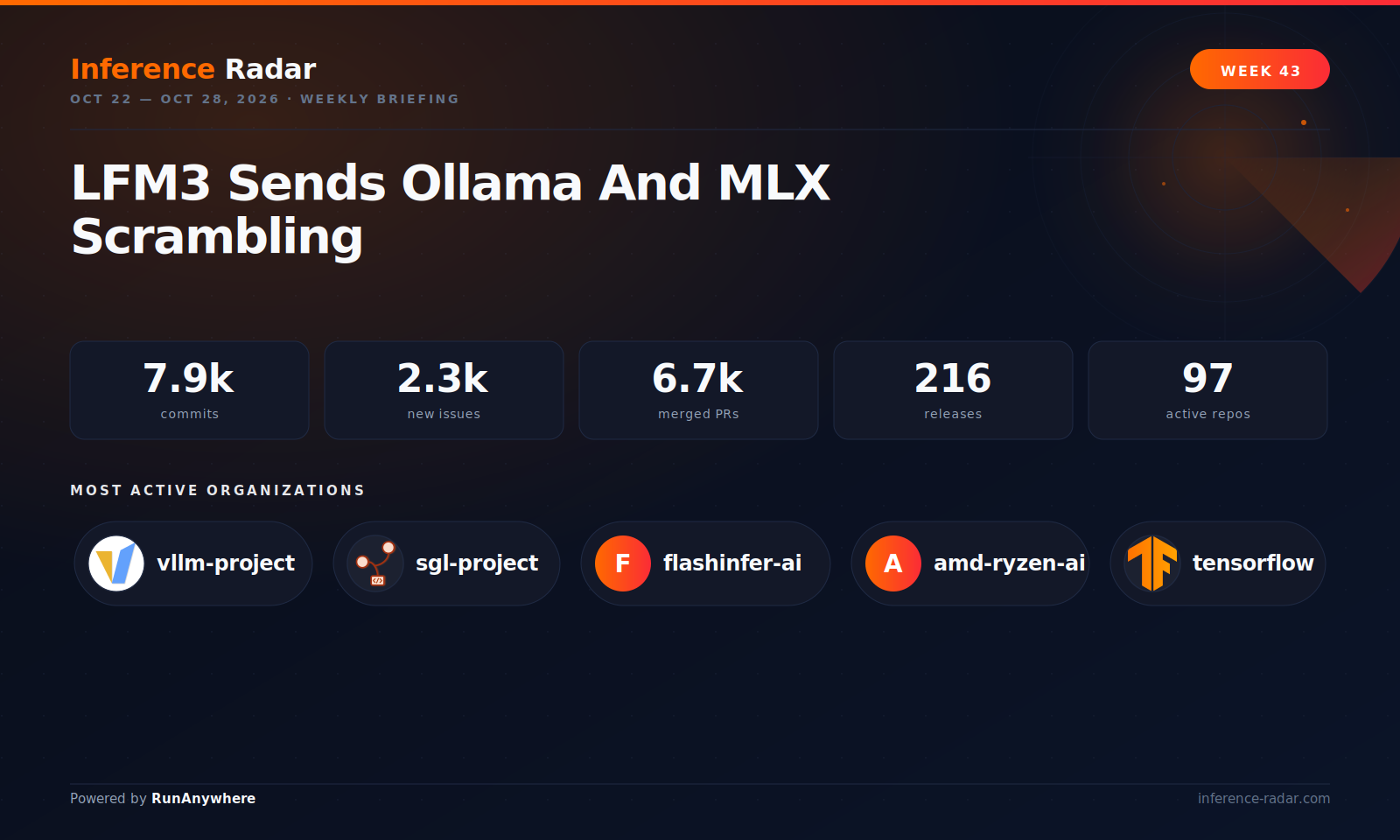
- LFM3 moved fast through the stack: LiquidAI model support showed up across local and edge runtimes, with Ollama, llama.cpp, MLX tools, and OpenVINO-related work all racing to make the family usable.1
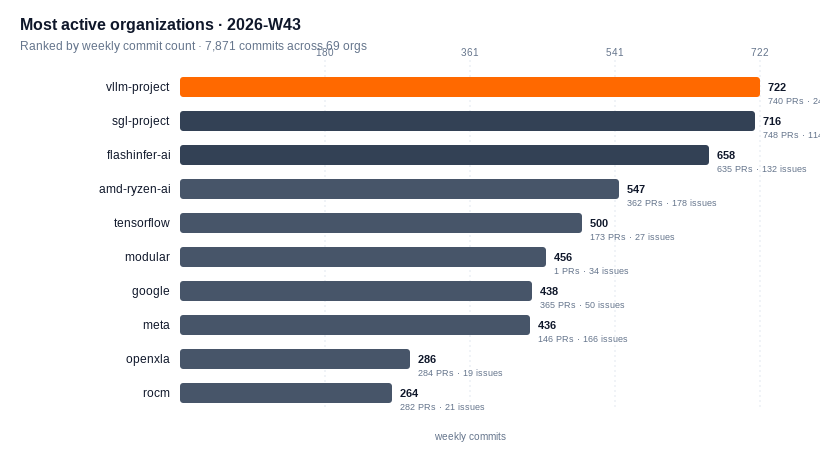
- KV cache became the main battleground: SGLang, vLLM, Dynamo, and Mooncake all pushed cache reuse, transfer, offload, and disaggregated serving work into core infrastructure, led by SGLang.2
- Security work hit the serving layer: LiteLLM, BentoML, LocalAI, Open WebUI, and others shipped fixes for signing, certificate, URL validation, dependency, and runtime exposure issues, with LiteLLM leading the most urgent response.3
- Kernel teams targeted new hardware directly: FlashInfer, TensorRT-LLM, ROCm AITER, FlashAttention, and Triton all pushed Blackwell, Rubin, MI-class AMD, and SM100 paths, with FlashInfer showing the widest kernel surface.4
- Edge speech and multimodal work accelerated: Google AI Edge, Qualcomm GenieX, FluidAudio, sherpa-onnx, and MLX audio projects expanded on-device ASR, TTS, VLM, and runtime packaging, with Google Gallery shipping visible app-level features.5
This Week in Inference
The external market signal was quiet, but the code signal was loud. Most model news showed up as runtime adoption rather than standalone model launches: LiquidAI’s LFM3 family moved into Ollama, llama.cpp, Apple MLX-adjacent tools, OpenVINO GenAI work, Qualcomm GenieX paths, and LiquidAI’s own docs and cookbook updates.1 NVIDIA’s Nemotron speech and vision work also spread through Hugging Face Transformers, FluidAudio, sherpa-onnx, Ollama, and ExecuTorch-related paths, which shows how fast model support now travels from model code to desktop and mobile apps.
The strongest optimization theme was memory movement. SGLang rebuilt large parts of its KV and HiCache stack, vLLM pushed KV offload, LMCache, NIXL, and MoRI paths, Mooncake hardened transfer engines and store HA, and Dynamo added global routing plus KV-cache and pool relay plumbing SGLang, vLLM, Mooncake, Dynamo.2 This is the shift from “fast attention kernel” to “memory fabric,” where prefill, decode, routing, cache identity, page ownership, and transfer failures decide real cost per token.
Hardware work stayed split across high-end datacenter GPUs and edge accelerators. FlashInfer, TensorRT-LLM, Triton, ROCm AITER, FlashAttention, and OpenXLA all worked on new GPU backend paths, while Google LiteRT, Qualcomm GenieX, Tencent ncnn, Apple MLX, and FluidAudio pushed mobile, NPU, Metal, WebGPU, and on-device speech work FlashInfer, TensorRT-LLM, LiteRT, GenieX.9 The same design pressure appears in both places: quantize more, move less, keep APIs stable, and make local execution behave like production serving.
Top Stories
Ollama, llama.cpp, MLX, and OpenVINO chase LFM3 support
LFM3 became the week’s clearest cross-stack model adoption story, with Ollama adding the LiquidAI family while llama.cpp, MLX tools, OpenVINO GenAI, Qualcomm GenieX, and LiquidAI docs all moved support or examples forward Ollama.1 This matters because LFM3 spans text, vision, audio, and omni use cases, so engines had to handle more than a simple transformer text path.
llama.cpp made the same broader point with a release focused on LiquidAI text, vision, audio, and omni support, plus realtime serving features llama.cpp.13 Local runtimes now compete on how quickly they can absorb multimodal families while preserving OpenAI-compatible APIs and usable packaging.
SGLang and vLLM turn KV cache into infrastructure
SGLang merged a broad KV-memory and HiCache refactor that covered allocator-owned cache identity, routed KV views, page-unified staging, transfer pins, and storage interfaces SGLang.2 vLLM pushed the same direction from another angle, with P2P KV offload fixes, tiering failure handling, NIXL push-mode selection, MoRI transfer paths, and Omni cache offload work vLLM.6
The important change is architectural. Engines now treat cache blocks, cache ownership, and cache transfer as serving primitives, not backend details hidden below scheduling.
LiteLLM, BentoML, LocalAI, and Open WebUI make safety a release theme
LiteLLM rotated image signing keys, warned users away from a compromised line, and shipped multiple signed backports after a security incident LiteLLM.3 BentoML responded to certificate-chain compromise risk with a security release, while LocalAI hardened user-supplied media URL handling and Open WebUI bumped vulnerable compression dependencies BentoML.14
These fixes sit at the layer where inference systems touch the internet: proxy images, generated Dockerfiles, media fetchers, model gateways, and web UIs. The safety work was less glamorous than new models, but production operators will feel it first.
FlashInfer, TensorRT-LLM, ROCm, FlashAttention, and Triton push the kernel frontier
FlashInfer shipped a large CUDA kernel wave across Blackwell and Rubin attention, MoE, GEMM, KDA, KCP, and GDN memory paths FlashInfer.4 TensorRT-LLM advanced Kimi K3, KV transfer, OpenEngine, Blackwell GLM paths, speculative decode fusion, and disaggregated serving pieces TensorRT-LLM.15
ROCm AITER and ATOM focused on MI-class GPU tuning for Qwen, DeepSeek, MiniMax, Kimi, and GLM workloads, while FlashAttention fixed FA4/CuTe bounds and SM100 correctness issues ROCm AITER.16 Triton added two-CTA execution, TMA synchronization, AMD backend work, and compiler verifier constraints Triton.17
Edge speech and multimodal inference got product-shaped
Google Gallery added on-device ASR, TTS, XR Language Teacher, live telemetry, and context management Google Gallery.5 Qualcomm GenieX shipped a signed HTP catalog and tied its SDK work to Android sample updates, while FluidAudio, sherpa-onnx, Blaizzy MLX audio, and Apple MLX projects all expanded speech and multimodal runtime support GenieX.18
The edge stack is no longer a stripped-down copy of server inference. It now has its own product requirements: microphone latency, language hints, diarization, TTS voices, mobile NPU packaging, app permissions, and local privacy behavior.
Deeper Dive
Everything below is for readers who want the full picture. Feel free to scroll.
Code Changes by Category
Cloud & Datacenter Serving
vLLM had one of the broadest serving weeks, spanning KV offload, speculative decoding, ROCm, Gaudi alignment, multimodal Omni work, frontend parser fixes, and CI packaging vLLM.6 SGLang matched that scale with KV-memory refactors, HiCache validation, DeepSeek and Qwen performance paths, and Omni realtime cleanup SGLang.2
NVIDIA focused TensorRT-LLM on release readiness, Kimi K3, OpenEngine, KV transfer, Blackwell paths, and package hygiene TensorRT-LLM.10 Dynamo added global discovery, global routing, Velo TCP, UCX response transport, Kubernetes sidecars, scoring, pooling, and SGLang KVCR HiCache discovery Dynamo.8
Ray hardened Train, Data, Serve, LLM serving, autoscaling, auth tokens, and sandboxing Ray.19 Triton Inference Server focused on gRPC stream cancellation, DCGM packaging, default image behavior, and SDK dependency cleanup Triton Inference Server.20
Local LLM Runtimes
llama.cpp shipped a major release with LiquidAI multimodal support, realtime APIs, backend acceleration, and ggml synchronization llama.cpp.13 Ollama shipped five rapid releases around LFM3, MLX, Phonon speech, DFlash draft decoding, coding-tool launchers, and llama.cpp bumps Ollama.21
LocalAI combined a large feature release with a fast security patch that tightened external media URL policy LocalAI.22 exllamav3 added sparse hot-vocab drafting, Nemotron Super-VL support, Gemma MTP, CPU-MoE loading improvements, and lower prefill VRAM exllamav3.23
vllm-mlx fixed prompt-cache reuse, hybrid MLLM checkpoints, constrained decoding, tokenizer wrapping, and JSON streaming behavior vllm-mlx.24 Rapid-MLX shipped a dense engine and desktop cycle around multimodal chat, local agent harnesses, parser demuxing, supply-chain verification, and model catalog work Rapid-MLX.25
Apple Silicon & MLX Ecosystem
Apple’s MLX stack added runtime config, sliding-window and split SDPA, quantization fixes, CUDA and distributed improvements, Swift/C bindings, and Swift LLM support for reasoning, Gemma channels, KV-cache masks, and observability MLX.26 CoreAI model tooling added Gemma VLM routing, speculative decoding groundwork, server batching, JSON constrained generation fixes, and export/compression work coreai-models.27
Blaizzy’s MLX ecosystem added Nemotron speech, Maya TTS, Granite Speech, Phonon fixes, many Swift audio models, and substantial mlx-vlm support for LFM3, Unlimited-OCR, diarized transcription, MiniCPM-OCR, Nemotron parsing, and MOSS memory reductions mlx-audio.28 Osaurus and OMLX both pushed Apple Silicon runtime work around DeepSeek, Lightning MTP, SSD cache, local app UX, and memory admission OMLX.29
Mobile & Edge Frameworks
Google AI Edge moved LiteRT, LiteRT-LM, litert-torch, XNNPACK, Gallery, MediaPipe, and samples forward around ASR, TTS, XR, NPU, Web, GPU, Qualcomm, Intel NPU, and Tensor backends Google AI Edge Gallery.5 Qualcomm shipped GenieX with a signed HTP catalog and AI Hub Apps with Ubuntu samples for image colorization and depth estimation GenieX.18
Tencent ncnn focused on RISC-V BF16 activations, INT8 packing, depthwise convolution speedups, Vulkan storage-buffer compatibility, and PNNX correctness reports ncnn.30 FluidAudio added Nemotron ASR, Paradee TTS, Bark-family ASR, Core ML conversion flows, and text-normalization performance fixes FluidAudio.31
sherpa-onnx made VoxLock target-speaker isolation a cross-language runtime surface and fixed ASR behavior across Whisper, Canary, NeMo, and streaming punctuation sherpa-onnx.32 ExecuTorch improved device placement, EXIR lowering, pybindings, Whisper export, HF LLM runner flows, CPU/XNNPACK kernels, and Qualcomm and Arm backend coverage ExecuTorch.33
Compilers, Runtimes & Graph Engines
Triton released a compiler update with two-CTA execution, TMA sync, NVIDIA and AMD backend fixes, Gluon runtime work, and sanitizer coverage Triton.17 OpenXLA pushed GPU GEMM layout, cuBLASLt autotuning, ROCm MORI, allocator recovery, CPU oneDNN fusion, Intel GPU support, TPU and Shardy cleanup, and dependency updates OpenXLA.34
JAX moved Linux wheels toward statically linked libc++, expanded HiJAX unreduced-array infrastructure, improved Pallas and Mosaic GPU/TPU paths, and fixed numerics and AD edge cases JAX.35 Apache TVM and tvm-ffi advanced TIRx alignment, Rust reflection, ORCJIT packaging, Windows ARM64 wheels, and paged KV metadata correctness tvm-ffi.36
OpenVINO added low-bit compression paths, GGUF import work, GPU fusions, CPU MoE prefill, NPUW fixes, and GenAI ASR/VLM model support OpenVINO.37 ONNX and ONNX Runtime added grouped expert matmul schema work, WebGPU fixes, CUDA quantized kernels, QMoE paths, OpenVINO GenAI support in Olive, and execution-provider reliability ONNX Runtime.38
Models, Quantization & Optimization
Hugging Face Transformers added Nemotron speech support, MiniCPM-OCR release work, FP8 QuantizedCache, FlashAttention/static-cache fixes, compressed-tensors support, and broad logits_to_keep coverage Transformers.39 Diffusers shipped a security release for component loading and a major release covering new image/video pipelines, adapter work, modular pipelines, and hardware integrations Diffusers.40
FlashInfer had the largest kernel burst, covering Blackwell and Rubin attention, MoE, GEMM, KDA, KCP, GDN, sparse MLA, sampling, Kimi, Qwen, softmax, and packaging FlashInfer.4 FlashAttention focused on FA4 and CuTe correctness around SM90 and SM100 TMA bounds, varlen attention, and GQA backward performance FlashAttention.41
ROCm AITER and ATOM added MI-class tuning, attention kernels, quantized MoE paths, DeepSeek/Qwen/MiniMax/Kimi support, and AMDMIGraphX graph rewrites AITER.16 Intel neural-compressor made smaller but focused fixes for low-bit LLM benchmarking, Coverity cleanup, and MiniMax MoE quantization neural-compressor.42
Other Notable Changes
Open WebUI fixed RAG/OCR, MCP failures, chat and folder state, accessibility, media integrations, and compression CVEs while shipping on-demand skill loading Open WebUI.43 LiteLLM spent the week on post-incident recovery, key rotation, guardrails, observability, budgeting, provider compatibility, and typing cleanup LiteLLM.44
BentoML shipped a certificate security release and started BentoCloud deprecation docs BentoML.14 RunanywhereAI’s Wally added hosted security-audit harnesses and gated-model access fixes, while SDK work staged MLX, LFM3, D1, and malformed UTF-8 repairs Wally.45
Community Pulse
Stars flowed toward the most visible user-facing runtimes: llama.cpp, Ollama, vLLM, SGLang, Open WebUI, and MLX-related projects all showed strong weekly growth in the supplied activity table llama.cpp, Ollama, vLLM, SGLang.2 The pattern tracks where users feel fast change: local model support, OpenAI-compatible serving, desktop UI, and fast multimodal runtime enablement.
Security reports stayed high-signal. LiteLLM users discussed attack-chain details and trusted image ranges, LocalAI users reported checksum and media-fetching issues, BentoML users surfaced multipart parsing behavior, and Open WebUI users raised privacy and local-fallback concerns LiteLLM, LocalAI, BentoML, Open WebUI.49
Hardware-specific issue traffic also stayed intense. Users reported FlashAttention H100 and B200 behavior, OpenXLA wrong-results cases, Triton SM100 and SM8x problems, TensorRT packaging gaps, and ROCm MI-series correctness issues FlashAttention, OpenXLA, Triton, TensorRT, AITER.52
Community Debates
vLLM and SGLang rejected broad cache and backend changes unless they fit current serving architecture. vLLM maintainers closed several hardware and KV proposals after scope, stale-main, or alternative-fix concerns, including Blackwell DeepSeek work and KV layout standardization vLLM debate.57 SGLang closed backend proposals such as NPU Mooncake transfer support and QuickReduce changes when maintainers found elastic-init, accuracy, or test coverage concerns SGLang debate.58
Compiler projects favored upstream fixes over local hacks. Triton maintainers rejected a local SM8x prefetch workaround because they wanted the spill problem fixed in LLVM InstCombine instead Triton debate.59 OpenXLA maintainers pushed back on ROCm FP8 fallback policy and SYCL convolution scope when proposed changes looked like broad backend policy shifts rather than tight compiler fixes OpenXLA debate.60
Local runtimes rejected model-specific shortcuts that would raise maintenance cost. llama.cpp closed FP4 KV-cache work over quality and benchmarking concerns, while Blaizzy declined model-specific Unlimited-OCR Metal kernels despite reported decode gains because the maintenance burden was too narrow llama.cpp debate, mlx-vlm debate.61 exllamav3 also split Nemotron Super-VL support away from CPU-offload complexity to keep model enablement simpler exllamav3 debate.63
Edge and mobile projects debated platform ownership. Google’s LiteRT and MediaPipe maintainers closed older accelerator and API proposals when paths were deprecated, internalized, or superseded by newer APIs LiteRT debate.64 Qualcomm GenieX maintainers rejected broad Android HTP microbatch defaults and kept the fix closer to upstream llama.cpp and runtime behavior GenieX debate.65
Worth Watching
KV-cache infrastructure now looks like the center of production inference. SGLang’s HiCache, vLLM’s KV offload, Mooncake’s transfer engine, Dynamo’s global routing, and LMDeploy’s prefix-cache fixes all point toward serving stacks that track cache identity, movement, reuse, and failure as first-class state SGLang, vLLM, Mooncake, Dynamo, LMDeploy.2
The LFM3 support race will test multimodal packaging. Runtimes need to handle text, VLM, audio, omni, GGUF, MLX, OpenVINO, Qualcomm HTP, and server APIs without fracturing user experience Ollama, Liquid docs.21
Security will keep moving closer to runtime policy. Signing keys, certificate bundles, URL fetch restrictions, RPyC loopback binding, CORS, local API keys, and gated model access all appeared in one week across independent projects LiteLLM, LightLLM, LocalAI, RunanywhereAI.22
Major Releases
AI Dynamo shipped v1.6.0 and v1.6.1, with the main feature release centered on router flow control, shared routing selection, scoring policy, and Kubernetes LPX/LPU-backed inference, followed by a patch for trust stores, Pillow, image tooling, and crate publishing.70
AMD Ryzen AI shipped FastFlowLM v1.0.10, GAIA v0.25.1 with several v0.25.2 release candidates, and Lemonade v2026.44.1, all focused on NPU model support, GUI and agent maturity, catalog updates, and serving fixes Lemonade release.71
Apache shipped tvm-ffi v0.1.15-post1, focused on Rust reflection registration, Rust stubgen naming, GCC tuple-test workarounds, Darwin symbol hiding, and ORCJIT packaging polish.36
Apple MLX shipped mlx-swift 0.33.0, aligning Swift bindings with MLX 0.32.4 and introducing source-breaking sendability changes around compile closures and custom functions.72
BentoML shipped BentoML v1.4.40 as a security release for the eMudhra intermediate CA compromise, requiring updated certifi and pinning generated Dockerfile uv installs with hashes.14
BerriAI shipped a dense LiteLLM backport train from v1.103.8 through v1.106.6 plus v1.109.0-dev.1, dominated by image-signing key rotation, trusted image guidance, CA cleanup, proxy startup fixes, failure-log trimming, and new-key verification Latest release.44
Blaizzy shipped mlx-audio v0.6.2 and v0.6.3, mlx-audio-swift v0.1.7, and mlx-vlm v0.7.11, with the week centered on Nemotron speech, Maya TTS, Swift audio runtime optimization, live STT WebSocket support, document parsing, and multimodal model coverage mlx-audio release.28
Dao-AILab shipped fa4-v4.0.0.beta37 for FlashAttention, focused on SM100 forward NaN fixes, Ruff formatting, and SM100 backward K/V TMA load bounding.41
FlashInfer shipped v0.7.2.post1 after a release-candidate train, highlighting FP8 and Prims-TS MoE on Rubin, die-local MoE and GDN decode, fused communication kernels, FP8-output all-reduce, Blackwell kernels, and Kimi K3 MLA packing.4
Fluid Inference shipped FluidAudio v0.18.0, adding Nemotron Unified ASR, Nemotron 3.5 Transcribe Lite, Bark 3.0, Canary translation, and related CLI examples.31
ggml shipped llama.cpp v0.8.0 plus many prereleases, with the main release centered on LiquidAI LFM3 text, vision, audio, omni, realtime APIs, DeepSeek, SenseNova, Beam, Kolibri, Flint, Muse Spark, and Granite Switch Decision support.13
Google AI Edge shipped Gallery 1.0.21 and 1.0.22, LiteRT v2.3.2, and MediaPipe v1.2.0, with user-facing work in ASR, TTS, XR Language Teacher, live telemetry, and context management, plus runtime stability fixes Gallery release.5
Hugging Face shipped diffusers v0.42.0 and v0.42.1 plus transformers v5.21.0, with the key production change being a diffusers security fix for trust_remote_code bypass risk and a Transformers release highlighting MiniCPM-OCR Diffusers security release.40
JAX shipped v0.12.0.1 as a Windows bugfix release, changing C++ intrinsic LLVM IR builds to use clang-cl so vectorized CPU intrinsics work on Windows.35
Jundot OMLX shipped v0.7.3.dev1, v0.7.3.dev2, and v0.7.3rc1, with the release train focused on Ask AI, GPU power limits, Lightning MTP, MiniMax support, DeepSeek prefill hotfixes, and Apple Silicon serving performance.29
k2-fsa shipped sherpa-onnx v2.0.0 and v2.0.1, with the patch release highlighting Flutter package fixes, Canary decoder-position fixes, VoxLock denoiser support, and updated build guidance.32
kvcache-ai shipped Mooncake v0.3.14-pre, a prerelease that builds CUDA 12, CUDA 13, non-CUDA, and NPU wheels, publishes to TestPyPI, and runs wheel smoke plus T-One integration validation.73
Meta PyTorch shipped PyTorch v2.15.0, headlined by a rewritten NCCL backend becoming the default and adding a flight recorder for hang dumps, alongside broad compiler, runtime, packaging, and security changes.74
Microsoft shipped Foundry Local v2.2.1, Foundry Local CLI preview releases, and ONNX Runtime v1.31.1, with the ONNX Runtime patch focused on an OpenVINO-enabled Python build regression and WASM Debug external-data tests ONNX Runtime release.38
Modular shipped MAX 26.7 and Mojo 1.2.0, adding Muse Glimmer, MiMo, video input for Qwen models, a Decisions API, request-aware speculative decoding, and dynamic verification-width selection.75
Mudler LocalAI shipped v4.12.0 and v4.12.1, with the feature release adding UI, streaming voice, decision routing, Qdrant stores, prompt-cache controls, and add-on groundwork, followed by a security patch for external URL policy Security release.22
NVIDIA shipped TensorRT-LLM v1.4.0rc1 and v1.4.0rc2 plus TensorRT Edge-LLM v0.11.1, with the Edge release adding the unified trtedge CLI and validated CuTe DSL artifacts TensorRT Edge-LLM release.76
Ollama shipped v0.40.9 through v0.40.13, moving quickly through Flint, Nemotron, macOS speech generation, d3 decision models, LFM3 text/VL/audio/omni, and Linux/Windows LFM3 runtime support Latest release.21
Open WebUI shipped v0.12.4, adding on-demand skill loading through admin settings or environment configuration so selected skills can be listed for model-side loading without always sending full instructions.43
OpenNMT shipped CTranslate2 v4.8.4, adding Python 3.15 wheels, experimental Drama 3 offline TTS, and CPU/GPU audio-model ops including CausalDepthwiseConv1D, ConvTranspose1D, DequantizeFP8, GatedDeltaNet, MoeTopK, and Snake.77
Osaurus shipped 0.25.25 through 0.25.28, focused on Flint runtime integration, DeepSeek-V4.1 Flash, dSpark, reasoning controls, harness runtimes, access-key protection, LFM3 media support, and mobile/channel fixes Latest release.78
Qualcomm shipped ai-hub-apps v0.40.0 and GenieX v0.10.0, with GenieX adding a Microsoft-signed HTP catalog for llama.cpp and ai-hub-apps adding Ubuntu image colorization and depth-estimation samples GenieX release.18
Rapid-MLX shipped v0.16.8 through v0.16.10 and matching Rapid Mac releases, centered on Flint support, Desktop loading UI, verified mirrors, dictation, multimodal chat, local agent harnesses, and faster LFM2 MoE generation Latest release.25
ROCm shipped AITER v0.1.27 with prebuilt manylinux wheels for gfx942 and gfx950, continuing the release line for MI-class kernel tuning and LLM serving paths.16
RunanywhereAI shipped Wally v0.8.14 through v0.8.18 plus cpp-desktop-v0.20.43, adding hosted security harnesses, gated-model launch fixes, account-visible gated models, access guidance, and a desktop kit pin Latest Wally release.45
SGLang shipped sglang-omni v0.2.0 plus Voxt v1.16.2 and v1.16.3, with the Omni release focused on CosyVoice3 PackedDiT defaults, compile and graph skipping, HiFT decode, and Qwen3-TTS code-predictor performance sglang-omni release.79
Triton shipped v3.9.0, covering frontend and dialect work, compiler/backend changes, AMD/HIP, NVIDIA, Gluon layout, kernels, Proton profiling, CI, build infrastructure, and docs.17
Try Mirai shipped Uzu 0.6.13, updating package references across Cargo, Swift, GUI, playground, extension, bindings, and docs while the week’s code focused on WebGPU and QTIP/trellis runtime alignment.80
Turboderp shipped exllamav3 v1.6.5, adding Nemotron Super-VL, lower prefill VRAM, hot and sparse-vocab drafting, faster AVX2 and AVX512-BW inference, faster expert-offload loading, Gemma MTP, and tokenizer fixes.23
vLLM Project shipped vllm-omni v0.32.0, aligning with vLLM 0.32.0 and highlighting Ray multi-node inference, session-aware replica placement, full-duplex serving, server VAD, RL weight transfer, and broader model support.81