TL;DR
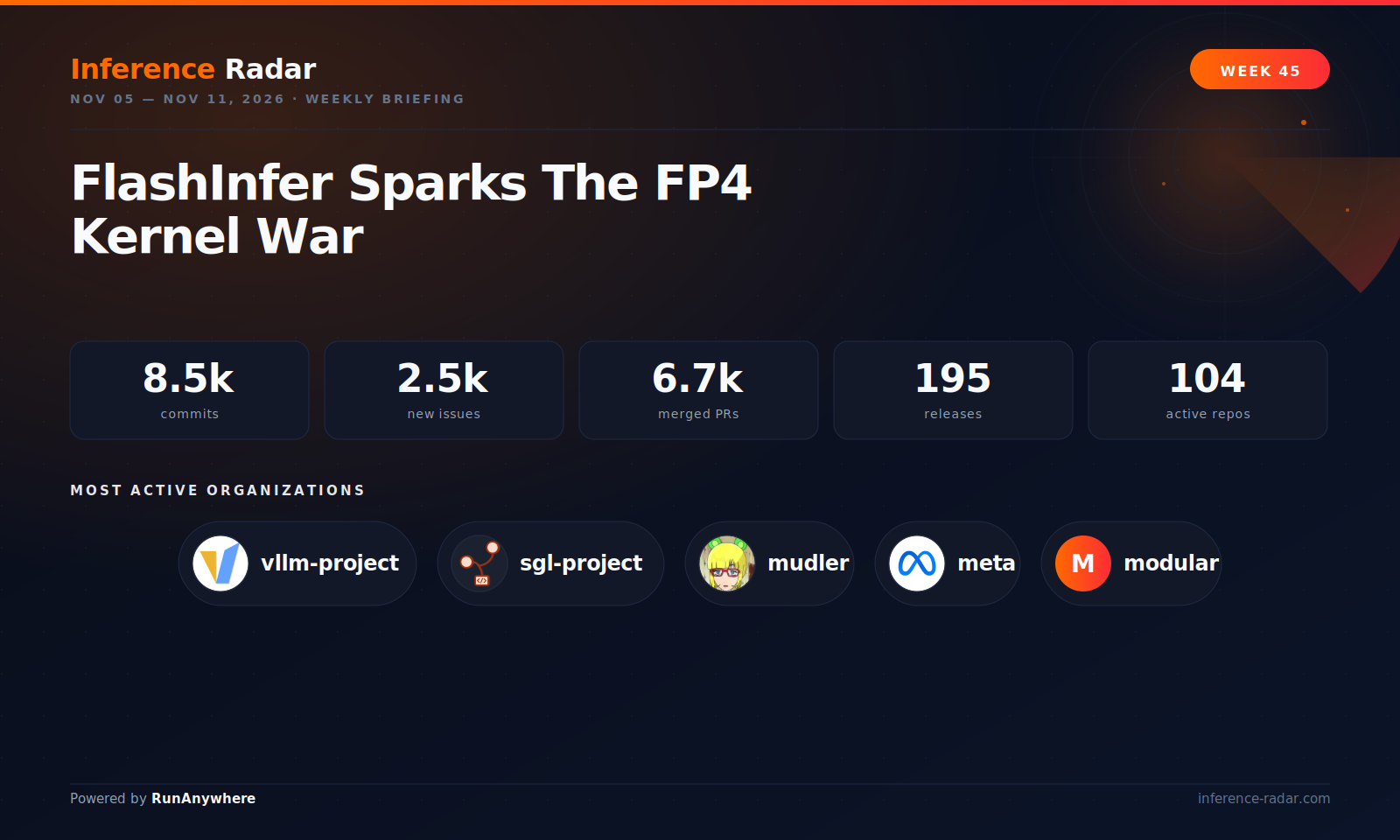
- Serving engines hardened the weird paths: vLLM, SGLang, TensorRT-LLM, FlashInfer, and ROCm pushed sparse attention, speculative decoding, MoE, and KV-cache work closer to production on mixed accelerators.1
- Mac inference grew up fast: Ollama, Apple MLX, Rapid-MLX, CTranslate2, and Voxt focused on batching, Metal and MPS, memory cuts, and voice workflows.2
- Edge stacks moved from demos to products: Google LiteRT, MediaPipe, ExecuTorch, ncnn, Qualcomm GenieX, and MNN added APIs, converters, and NPU paths for deployable apps.3
- Kernel teams chased low precision everywhere: FlashInfer, FlashAttention, CUTLASS, Triton, AITER, and TensorRT-LLM worked on FP8, MXFP, NVFP, sparse MLA, and next-generation GPU correctness.4
- Agent UX moved into local runtimes: Open WebUI, LocalAI, LiteLLM, Osaurus, and Foundry Local turned terminals, tools, decision models, and accounting into first-class serving concerns.5
This Week in Inference
The week’s model activity showed up inside infrastructure repos rather than as a broad outside launch cycle. Ollama added Ripple Preview, described in its release notes as a sixty-five-billion-parameter dense agentic coding model from Ricursive Intelligence, while Hugging Face Diffusers added MiniMax H3 Image and PAN 2 text and image-to-video workflows in its main branch work Ollama.6 Google’s LiteRT-LM added Gemma 4 multimodal support on Artisan GPU, and Qualcomm’s AI Hub Models expanded Qwen3-ASR, Parakeet TDT, LFM3, and GenieX model metadata paths for edge deployment LiteRT-LM.7
The dominant optimization story was cache and draft control. SGLang and vLLM both pushed speculative decoding, DSA, Kimi, DeepSeek, GLM, and multimodal PrefixLM paths, while FlashInfer and FlashAttention focused on sparse MLA, MoE, MXFP, NVFP, and SM100-era attention kernels SGLang.8 Local runtimes faced the same constraint at smaller scale: Ollama cut Apple Silicon memory for Qwen3.8 Flash Next, Rapid-MLX tuned its lattice dispatch layer, and CTranslate2 added an explicit MPS backend for Apple Silicon GPU inference CTranslate2.9
Hardware news came through enablement work rather than vendor announcements. NVIDIA’s TensorRT-LLM and CUTLASS work tracked Blackwell, Rubin, FP8 KV cache, sparse KV offload, and SM100 correctness; ROCm pushed MI-series serving through AITER, ATOM, and MIGraphX; and Google, Qualcomm, Meta, Tencent, and Alibaba all advanced mobile and edge NPU paths TensorRT-LLM.10 The industry move inside open source was packaging and control planes: LiteLLM unified deployment and accounting, Open WebUI shipped agent terminal flows, and Microsoft Foundry Local added ranking and decision sessions across SDKs LiteLLM.11
Top Stories
vLLM and SGLang turn heterogeneous serving into the default
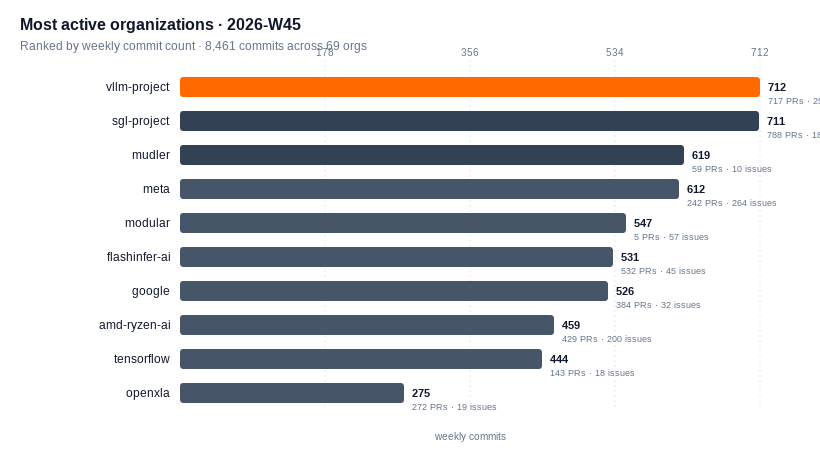
vLLM spent the week fixing runtime correctness while expanding AMD ROCm, NVIDIA Confidential Computing, Intel XPU, Intel Gaudi, and omni-modal serving coverage vLLM.1 SGLang matched that with speculative decoding, DSA, DeepSeek, Kimi, ROCm, Ascend, Apple, and Voxt work across its core and omni repos SGLang.8
The signal is clear: the leading OpenAI-compatible engines now treat hardware diversity as a normal serving condition, not a portability bonus. That shifts engineering pressure from raw throughput to predictable cache behavior, parser correctness, and scheduler policy under mixed model families vLLM issues.12
Low-precision kernels became the week’s main battleground
FlashInfer shipped a large release around sparse MLA decode, MXFP4 expert-parallel MoE, batch-invariant GEMM modes, SDSA, MiniMax-M3 indexers, and Gemma 4 NVFP4 KV-cache decode FlashInfer.13 FlashAttention focused on SM100 CuTe paths, MXFP8 support, GQA varlen serving fixes, and head-dimension backward consolidation FlashAttention.14
CUTLASS, Triton, TensorRT-LLM, ROCm AITER, and Intel Neural Compressor all worked the same seam: make low precision fast without making outputs wrong Triton.15 The practical fight has moved from “does FP8 work” to “which scale layout, tile shape, cache path, and expert route survives production traffic.”
Apple Silicon became a serious inference target across five stacks
Ollama added concurrent MLX generation, reduced wired memory for a large Qwen model on Apple Silicon, and kept moving its llama.cpp and MLX integrations forward Ollama.6 Apple’s own MLX ecosystem fixed CUDA and Metal portability, added MLX-LM sparse prefill work, and expanded Swift LLM model and tool-call support Apple MLX.16
CTranslate2 added an explicit MPS backend, Rapid-MLX shipped a dense engine and Desktop cycle, and SGLang’s Voxt release turned local speech input into a product layer for macOS Voxt.17 Apple Silicon inference now spans servers, desktop apps, speech, diffusion, and developer SDKs, with memory policy as the main constraint.
Edge runtimes moved closer to full application stacks
Google’s LiteRT, LiteRT-LM, MediaPipe, XNNPACK, Gallery, and samples repos moved together across Gemma 4 multimodal paths, Decision Maker demos, Swift and Android packaging, CLI verification, and kernel work Google AI Edge.3 Meta’s ExecuTorch added Vulkan, CUDA, OpenVINO, Qualcomm, XNNPACK, Arm, and packaging improvements while PyTorch core kept fixing compiler and export behavior that edge stacks depend on ExecuTorch.18
Tencent ncnn added PyTorch ExportedProgram import support and RISC-V BF16/RVV acceleration, while Qualcomm GenieX added decision models, recurrent-state handling, and Windows/Android runtime fixes ncnn.19 The edge stack is no longer just “run a tensor graph,” it is model catalogs, app samples, exports, quantization metadata, and runtime error handling.
The agent layer moved into serving infrastructure
Open WebUI’s release train added coding agents through Open Terminal-backed models, side-chat parity with the main chat stack, sub-agent governance, tool-call fixes, and Docker recovery Open WebUI.20 LiteLLM focused on deployment consolidation, SpendLogs accounting, OpenAI-compatible Responses streaming, video APIs, MCP identity, and repo reorganization LiteLLM.11
Foundry Local added ranking and typed-decision sessions, Osaurus shipped a major Mac agent release, LocalAI built a workspace UI, and ai-dynamo hardened distributed routing, tool calls, and Kubernetes operations Foundry Local.21 Inference products now own agent lifecycle, accounting, local tools, and approval flows alongside token generation.
Deeper Dive
Everything below is for readers who want the full picture. Feel free to scroll.
Code Changes by Category
Cloud & Datacenter Serving
vLLM had the broadest datacenter-serving week, with correctness fixes across pooling, KV-cache sizing, shutdown, data-parallel collectives, FlashInfer attention, ROCm AITER, NVIDIA Confidential Computing, Intel XPU, Gaudi integration, and omni-modal serving vLLM.1 SGLang matched the scale with DSA, DeepSeek, Kimi, EAGLE, FlashInfer, ROCm, Ascend, Rust router, OpenAI-compatible validation, and omni-modal speculative decoding work SGLang.8
TensorRT-LLM added Gemma4 variable-window attention, FP8 KV cache, fused DSA prefill indexing, sparse KV offload, GLM-5.3-Flash, MiniMax-M3, and serving fixes, while CUTLASS chased SM100 and TMEM correctness TensorRT-LLM.22 Triton Inference Server focused on production test reliability, including metrics polling, long-running stress behavior, and S3-backed Python backend startup timeouts Triton Server.23
ai-dynamo hardened distributed inference across vLLM, SGLang, TRT-LLM, routing, tool calls, Kubernetes operations, multimodal requests, and model support snapshots ai-dynamo.24 Ray pushed Data, Serve, Serve LLM, runtime environments, sandboxing, and storage integrations that matter for large inference pipelines Ray.25
Local LLM Runtimes
llama.cpp drove ggml’s week with backend acceleration, server hardening, MoE cache work, UI refreshes, Kimi K3.1 vision, FP8 KV cache, NVFP4 fused FFN, deterministic Top-K, WebGPU, Vulkan, Metal, SYCL, ROCm, and Hexagon fixes llama.cpp.26 whisper.cpp absorbed a large ggml sync and fixed VAD, server, backend validation, and segment timing issues whisper.cpp.27
Ollama focused on MLX concurrent generation, Ripple Preview support, Qwen memory cuts on Apple Silicon, llama.cpp updates, Vulkan iGPU mmap, Windows ARM64 CUDA, and OpenAI-compatible API fixes Ollama.6 LocalAI added a large workspace and UI system, rebranding infrastructure, downloader fixes, backend bumps, GPU memory reporting, and ROCm planning LocalAI.28
exllamav3 improved speculative decoding, quantized KV-cache access, shared disk-cache adoption, large-tensor quantization memory use, and MoE runtime efficiency exllamav3.29 llamafile added CLI support for decision models, fixed ARM legacy-quant accuracy, and refreshed transcribefile internals llamafile.30
Apple Silicon & MLX Ecosystem
Apple’s MLX stack fixed runtime correctness across CUDA macro handling, CUDA gradients, CPU quantized matmul precision, GPU sorting, and operation docs, while mlx-lm added a fused Metal DSA sparse-prefill kernel MLX.16 mlx-swift-lm expanded LiquidAI model support, mid-turn steering, speculative decoding, tool-call parsing, checkpoint loading, and VLM rotary behavior mlx-swift-lm.31
Rapid-MLX shipped engine tuning, Desktop onboarding, local search, multimodal lifecycle, OpenAI and Anthropic compatibility, benchmark upload safeguards, and a Desktop release Rapid-MLX.32 CTranslate2 added an explicit Apple Metal/MPS backend with FP32, FP16, BF16, INT8 paths and opt-in device="mps" behavior CTranslate2.9
SGLang-omni’s Voxt release made local macOS voice input a first-class app, while Neywa Labs pushed MLX audio and VLM work across Python and Swift Voxt.33 Apple’s Core AI repos added EmbeddingGemma export, native-quantized embeddings, Differential K-Means palettization, and Core AI optimization release work coreai-optimization.34
Mobile & Edge Frameworks
Google AI Edge moved across LiteRT, LiteRT-LM, litert-torch, MediaPipe, XNNPACK, Gallery, CLI, and samples, with Gemma 4 multimodal, Decision Maker demos, NPU and OpenVINO paths, Swift and Android packaging, and kernel work LiteRT-LM.7 Meta ExecuTorch added backend work for Vulkan, CUDA, OpenVINO, Qualcomm, XNNPACK, MLX, native Hugging Face, and Arm, while PyTorch core fixed compiler and export foundations ExecuTorch.35
Tencent ncnn added PyTorch ExportedProgram import, RISC-V BF16 storage and inference, RVV RMSNorm and RotaryEmbed, Vulkan reduction fixes, Mali cooperative-matrix fixes, and operator optimizations ncnn.36 Qualcomm coordinated AI Hub Models, AI Hub Apps, and GenieX across LFM3, Qwen3-ASR, Parakeet, decision models, QAIRT recurrent state, Windows NPU thread caps, and Android GPU tests GenieX.37
Alibaba MNN added chat and embedding serving, iOS app work, MiniCPM-OCR, Hexagon/QNN/Vulkan fixes, and KleidiAI kernels, while rtp-llm advanced pipeline parallelism and Ascend speculative paths MNN.38 Paddle-Lite had no landed code but received a detailed TIM-VX 5D reshape failure report for PP-OCRv3 on VeriSilicon NPU hardware Paddle-Lite.39
Compilers, Runtimes & Graph Engines
Triton focused on Blackwell and GB300 enablement, FP6/TMA tensor maps, MMAv5 correctness, warp-specialization fixes, AMD backend work, and frontend interpreter cleanup Triton.40 OpenXLA worked on CUDA allocator locality, GPU codegen, PJRT and IFRT APIs, XTile collective attributes, HLO and SPMD correctness, and build tooling OpenXLA.41
TensorFlow moved default builds to Bzlmod, advanced XLA/PJRT/IFRT, fixed numerical issues, and updated TFLite Micro embedded kernels and build paths TensorFlow.42 TVM’s ecosystem split was visible through core Relax importer work and tvm-ffi’s Rust/runtime release stabilization tvm-ffi.43
OpenVINO core added GPU sparse-attention fusion, MoE int3 DPAS decode, NPU compiler updates, NPUW fixes, and GenAI export/ASR improvements OpenVINO.44 ONNX and ONNX Runtime moved opset 29, WebGPU, CUDA, MoE/QMoE, Foundry Local integration, OpenVINO EP packaging, and session-creation performance forward ONNX Runtime.45
Models, Quantization & Optimization
FlashInfer shipped the week’s biggest low-level release with sparse MLA decode, MXFP4 expert-parallel MoE, batch-invariant GEMM modes, SDSA, MiniMax-M3 indexers, and Gemma 4 NVFP4 KV-cache decode FlashInfer.13 FlashAttention’s FA4 beta added dense 2CTA MQA padding, FA2 cache fixes, SM107 SMEM descriptor fixes, and SM100 backward coordinate changes FlashAttention.14
ROCm’s AITER, ATOM, and MIGraphX pushed GLM, Qwen, Gemma, Kimi, DeepSeek, MiniMax, FP8, MXFP4, attention, KV-cache, FlyDSL, and provider-interface work for MI-series GPUs AITER.46 Intel Neural Compressor fixed NVFP4 MoE scale handling for vLLM QDQ paths and planned QAD architecture for Qwen-style recipes Neural Compressor.47
Hugging Face Transformers added exporter work, LFM3-VL, JEV/decision-core support, vLLM Omni backend support, cache fixes, quantization fixes, and pipeline cleanup, while Diffusers added MiniMax H3 Image and PAN 2 Transformers.48 Optimum Intel added OpenVINO export and runtime coverage for LiquidAI, DSpark, DFlash, and NNCF scoped compression Optimum Intel.49
Other Notable Changes
LiteLLM unified Helm and Docker deployment paths, made SpendLogs ledger the default accounting architecture, added Responses streaming semantics, expanded video API fields, and reorganized the repo under litellm/ LiteLLM.11 Open WebUI shipped coding agents, side-chat parity, sub-agent governance, tool-call fixes, compaction fixes, and Docker image recovery Open WebUI.20
Microsoft Foundry Local added ranking and decision sessions across C++, C#, JavaScript, Python, and Rust SDKs, while Olive and ONNX Runtime kept aligning EP packaging and runtime behavior Foundry Local.50 Osaurus shipped a major Mac agent release with Remote Access fixes, workspace tools, model catalog updates, release automation, and crash/performance fixes Osaurus.51
Community Pulse
The week’s busiest community zones were vLLM, SGLang, Open WebUI, FlashInfer, ROCm, Google AI Edge, and OpenVINO, with issue traffic centered on cache correctness, tool-call parsing, hardware-specific failures, and packaging integrity vLLM issues.12 Open WebUI saw high-volume user feedback around reasoning, tools, Docker images, web search, compaction, and agent safety after its release train Open WebUI issues.52
Apple-adjacent projects gained attention because multiple stacks now target the same local workflow: Ollama, Rapid-MLX, CTranslate2, MLX, Voxt, llamafile, and Core AI all shipped Apple Silicon work in the same week CTranslate2 MPS.53 Edge users filed detailed, hardware-specific bugs in Paddle-Lite, ncnn, Qualcomm GenieX, OpenVINO, MediaPipe, and TensorRT-Edge-LLM, which suggests that mobile and NPU inference has moved into real user testing rather than lab demos ncnn issues.54
Community Debates
Ollama’s Unix socket support drew user interest for terminal and SSH-forwarding workflows, but maintainers closed the proposal while Host-origin and 403 behavior remained unresolved Ollama.55 The same repo consolidated several parser fixes for Qwen and FunctionGemma tool handling into a single path rather than merging small overlapping PRs Ollama parser consolidation.56
Google’s samples teams pushed back on richer demo complexity where maintainers wanted minimal examples, especially around MediaPipe JavaScript LLM buffering and an admin-panel app sample MediaPipe samples.57 The pattern matched other Google closures where large or toolchain-level changes landed through narrower, more maintainable routes litert-samples.58
vLLM closed or superseded several ambitious memory and backend proposals, including FlashInfer persistent workspace reservation, HiSparse direct GPU landing, split FP8 loading, and broader draft hf-overrides work vLLM FlashInfer workspace.59 The pushback was less about whether the ideas mattered and more about conflicts, crash reports, loader design churn, and narrowing the first merge vLLM HiSparse.60
Open WebUI’s maintainer process stayed strict: multiple PRs closed before technical review because of CLA, branch, template, linked-issue, title, or commit-shape requirements Open WebUI.61 That can frustrate contributors, but it also reflects a project trying to keep release velocity under control while adding agent and terminal features Open WebUI releases.20
DeepSeek had a narrow MoE inference correctness PR that replaced view with reshape for non-contiguous inputs, with tests and supportive peer feedback, but the PR closed without a visible maintainer objection DeepSeek.62 That closure stood out because many other projects at least redirected similar fixes into follow-up work DeepSeek issues.63
Worth Watching
Sparse MLA and low-precision MoE will stay hot next week because FlashInfer, FlashAttention, TensorRT-LLM, AITER, SGLang, vLLM, and OpenVINO all touched the same serving shapes and scale layouts FlashInfer issues.64 Apple Silicon inference should keep accelerating because Ollama, Rapid-MLX, MLX, CTranslate2, Voxt, llamafile, and Foundation Lab all moved user-facing local workflows Rapid-MLX.65
Agent runtimes now need cache policy and safety policy at the same time, as Open WebUI, LiteLLM, LocalAI, Osaurus, Foundry Local, ai-dynamo, and Microsoft’s decision APIs all moved into tool and terminal territory LiteLLM MCP discussion.66 Edge and NPU users are finding hard failures in real deployments, so expect more work around TIM-VX rank limits, Qualcomm VLM crashes, OpenVINO NPU conversion, MediaPipe telemetry, and ncnn Vulkan correctness OpenVINO issues.67
Major Releases
Version numbers and release links live here as the canonical reference list.
ai-dynamo shipped v1.6.2 plus experimental Kimi K3.1 Pro and DeepSeek-V4.1-Flash snapshots, with the stable patch focused on image refreshes, SGLang Python updates, TRT-LLM token-budget errors, and opt-in SGLang GC freeze. The experimental builds show ai-dynamo’s role as a distributed serving integration layer for new model families..68
AMD Ryzen AI shipped FastFlowLM v1.0.12, GAIA v0.25.4, a long GAIA v0.26.0 RC train, and Lemonade candidate releases. The dominant theme was local Ryzen AI product hardening across NPU runtime, agent UX, decision models, zero-shot routing, and model catalogs. FastFlowLM release.69
Apache shipped tvm-ffi v0.1.16 after multiple release candidates. The release locked down Rust API, reference counting, structural equality, stub generation, DLPack, CUDA, and runtime safety work that supports TVM’s modular runtime direction..43
Apple shipped coreai-optimization v0.4.0, adding Python 3.14 support, a public Torch export backend, optimizer state_dict preparation support, and dependency pins for the Core AI stack. The release complements active Core AI model export and MLX ecosystem work..34
BerriAI shipped LiteLLM v1.109.0 plus signed-image LTS and prerelease builds. The stable release was the largest platform release of the week, with routing and fallback migration notes, accounting changes, deployment consolidation, provider fixes, and API compatibility work..11
Neywa Labs shipped mlx-audio v0.6.5 and mlx-audio-swift v0.1.9. Both releases focused on TTS decoder behavior, Qwen3-TTS fixes, Voxtral streaming context, and Python/Swift parity for MLX audio. mlx-audio release.70
Dao-AILab shipped fa4-v4.0.0.beta39 for FlashAttention. The prerelease highlighted dense MQA head-count padding, FA2 cache fixes, SM107 descriptor fixes, and SM100 backward coordinate changes..14
FlashInfer shipped v0.7.4 after two release candidates. The release centered on DeepSeek sparse MLA decode, Rubin and Blackwell MoE, batch-invariant quantizer modes, SDSA, MiniMax-M3 indexers, and Gemma 4 NVFP4 KV-cache decode..13
FluidInference shipped FluidAudio v0.18.3 plus text-processing-rs v0.3.2 and v0.3.3. The releases improved Kokoro Mandarin, streaming callbacks, crates.io and npm packaging, Italian text normalization, source-aligned TN, and sentence-mode fixes. FluidAudio release.71
ggml published a dense llama.cpp prerelease train from b12121 through b12292. The train carried FP8 KV cache, NVFP4 fused CUDA FFN, MoE cache work, deterministic Top-K, external PLE loading, and backend fixes across Vulkan, Metal, SYCL, OpenCL, Hexagon, zDNN, WebGPU, and mtmd. Latest release.26
Google shipped LiteRT-LM v0.19.1 and MediaPipe v1.2.3. LiteRT-LM focused on Gemma 4 multimodal Artisan GPU and C API changes, while MediaPipe focused on LiteRT alignment, CPU-only accelerator registration, SemanticRetriever file paths, and framework cleanup. LiteRT-LM release.7
Hugging Face shipped Transformers v5.22.2. The patch release focused on security and distributed fixes, including NCCL-only device_id setting and hardened Jinja sandboxing..48
k2-fsa shipped the fa-models release for sherpa-onnx forced alignment. The release included acoustic models, pronunciation dictionaries, documentation, and assets for sherpa-onnx-fa..72
Microsoft shipped Foundry Local v2.4.0 and v2.4.1. The main release added ranking and typed-decision models across SDKs, and the patch fixed Native AOT serialization, ranking probabilities, macOS/iOS Objective-C conflicts, and telemetry. Latest release.21
MLC AI shipped web-llm v0.2.88. The release fixed prompt echo, logprobs, UTF-8 logprob buffering, decode-rate reporting, TypeScript package checking, and upgraded web runtime packaging..73
NVIDIA shipped TensorRT-LLM v1.4.0rc3. The prerelease notes were heavy on known issues around DSA, NVFP4 KV correctness, Kimi K3 DSpark and MegaMoE on GB300, DeepSeek-V4-Pro memory pressure, and RPC orchestration..10
Ollama shipped v0.40.16 and v0.40.17-rc0. The stable release added Ripple Preview, reduced Apple Silicon memory for Qwen3.8 Flash Next, fixed Claude routing, and improved /v1/responses truncation behavior..6
Open WebUI shipped v0.13.1, v0.13.2, and v0.13.3 in one release train. The sequence added coding agents, fixed plain-HTTP and LAN failures, and expanded automations with terminal, folder, and agent selection. Latest release.20
OpenNMT shipped CTranslate2 v4.9.0. The headline feature was an experimental Apple Metal/MPS backend, with ROCm wheel target expansion, CUDA build modernization, and release gates..9
Qualcomm shipped ai-hub-models v0.66.0, ai-hub-apps v0.41.0, and GenieX v0.10.1-alpha.3. The releases covered new model catalog entries, Ubuntu video-classification app assets, QAIRT/GenieX model paths, and Windows on Snapdragon signing. ai-hub-models release.74
ROCm shipped AITER v0.1.29 and v0.1.28.post1. Both published manylinux wheel assets for gfx942 and gfx950, matching the week’s heavy AITER kernel and provider-interface work. Latest release.46
Osaurus shipped 1.0.0, 1.0.1, 0.25.32, and 0.25.33. The main launch positioned Osaurus as a private Mac-based team of agents, while the patch release fixed release lanes, working-folder inheritance, queued imports, workflows, UI polish, crashes, and performance. Latest release.51
Rapid-MLX shipped v1.0.2 and rapid-mac-v1.0.2. The release added video generation with sound, cancellation, idle unloading, faster first-run defaults, Hugging Face link installs, Chinese localization, and accessibility fixes. Desktop release.65
SGLang shipped Voxt v2.0.0, v2.0.1, and v2.0.3 through sglang-omni. The releases rebuilt Voxt as a local-first macOS voice input app, added remote language model cleanup and rewrite through OpenAI-compatible APIs, and clarified Apple Silicon and macOS requirements. Latest release.17
try-mirai shipped lalamo v0.19.0. The release covered test fixes, Discord release messaging, quantization-parameter resharding, tool-call support, and CPU batching via lalamo server --batch-size..75
Zetic AI shipped Zetic MLange iOS SDK 1.12.0, 1.13.0, and 1.13.1 as Swift Package metadata updates. The releases retargeted signed XCFramework artifacts and checksums for iOS package consumers. Latest release.76