TL;DR
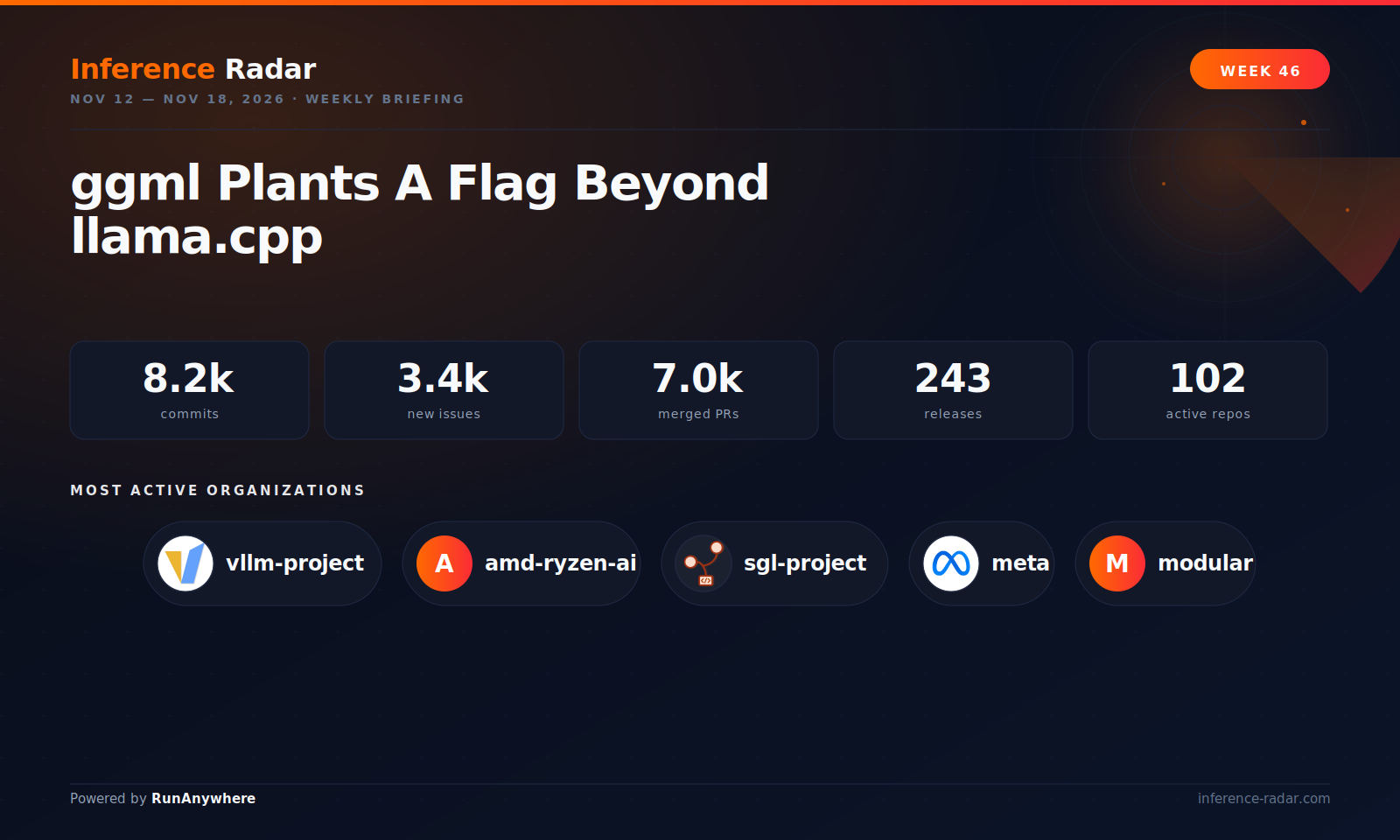
- ggml crossed a line: llama.cpp shipped its first stable release while whisper.cpp synced to the same ggml baseline, turning the local runtime stack into a more formal platform.1
- Serving engines hardened their cores: vLLM, SGLang, TensorRT-LLM, and Ray all focused on runner architecture, scheduler correctness, cache behavior, and production serving paths.2
- Low-bit inference moved into standards and kernels: ONNX, ONNX Runtime, OpenVINO, FlashInfer, ROCm AITER, and TensorRT pushed packed quantization, FP4, FP8, MoE, and KV-cache execution deeper into runtime layers.3
- Local AI became product infrastructure: LocalAI, Open WebUI, Osaurus, Rapid-MLX, oMLX, and Voxt all expanded desktop, agent, workspace, or Apple Silicon user surfaces.4
- Edge stacks chased the same serving problems: LiteRT, ExecuTorch, ncnn, sherpa-onnx, MediaPipe, and Qualcomm AI Hub all advanced low-bit, sparse attention, NPU, or mobile deployment paths.5
This Week in Inference
No standalone model-provider launch dominated the supplied market briefing, but the repo data showed a broad model-enablement wave across inference stacks. Hugging Face Transformers added or expanded support for Apertus, Lara Mini, Omnilingual ASR, GraniteForDocling, BailingHybrid, and related architectures, while SGLang added paths for DeepSeek, Kimi, LFM, and multimodal workloads across core and omni repos (Transformers, SGLang).6 vLLM, TensorRT-LLM, LMDeploy, MLC-LLM, WebLLM, MLX, llama.cpp, and OpenVINO all spent the week turning recent model families into runnable serving targets rather than announcing new model families themselves (vLLM, TensorRT-LLM).2
The technique story was clear: memory and routing now set the cost curve. ONNX added packed low-bit primitives, ONNX Runtime accelerated GGUF and MoE packed execution, OpenVINO exposed KV-cache block metadata for continuous batching, FlashInfer shipped batch-invariant kernels and Blackwell/Rubin paths, and ROCm AITER plus ATOM pushed FP4, MXFP8, MoE, and KV transport across AMD GPUs (ONNX, OpenVINO, FlashInfer, ROCm AITER).10 Speculative decoding, prefix reuse, cache offload, and disaggregated prefill/decode showed up in vLLM, SGLang, TensorRT-LLM, Mooncake, Ray, oMLX, Ollama, Rapid-MLX, and WebLLM, which suggests the memory wall has become a cross-runtime product issue rather than a datacenter-only concern (Mooncake, WebLLM).12
Hardware news also came through code. NVIDIA aligned TensorRT, TensorRT-LLM, TensorRT-Edge-LLM, and CUTLASS around CUDA, Blackwell, Rubin, Jetson Thor, CuTe DSL, speculative decoding, and MoE serving paths (TensorRT, CUTLASS).14 Google’s LiteRT, XNNPACK, MediaPipe, and litert-torch work pointed at a dense mobile and browser edge roadmap, while Tencent ncnn, Qualcomm GenieX, ExecuTorch, and sherpa-onnx advanced the same low-bit and device-backend questions on Android, Vulkan, Snapdragon, and embedded targets (LiteRT, ncnn, GenieX, ExecuTorch).17
Top Stories
ggml makes local inference feel like a platform
llama.cpp shipped its first stable release with API cleanup, ggml baseline alignment, speculative APIs, FP8 KV cache, MoE controls, audio endpoints, and server UI work (llama.cpp).1 whisper.cpp synced to the same ggml baseline and adjusted its llama integration, which matters because speech, local LLM serving, and desktop apps now share more of the same backend substrate (whisper.cpp).19
vLLM forces the runner transition
vLLM made its newer GPU model runner the only supported GPU path and enabled extensible KV cache by default in its headline release (vLLM).2 Gaudi and Omni had to follow quickly, with HPU vendoring work, runner adaptation, duplex serving changes, and multimodal MRv2 alignment across their plugin repos (vllm-gaudi, vllm-omni).21
Low-bit formats moved from ad hoc kernels into contracts
ONNX added packed low-bit primitives and a packed dequantization path that directly targets GGUF and NF4-style payloads (ONNX Pack, ONNX DequantizePacked).3 ONNX Runtime then pushed hybrid GPU/CPU MoE packed execution and GGUF packed CUDA kernels, which turns model-file compression into a runtime scheduling problem rather than a loader detail (ONNX Runtime).23
Apple Silicon local AI became a product race
Apple’s MLX ecosystem fixed dtype, zero-size, and Swift runtime safety issues while MLX Swift LM expanded model coverage (MLX, mlx-swift-lm).25 Around it, oMLX, Rapid-MLX, LocalAI, Osaurus, Voxt, and Cactus all shipped or merged product-facing local inference work for desktop agents, Apple Metal kernels, MLX serving, and offline multimodal use (oMLX, Rapid-MLX, LocalAI).4
The kernel layer absorbed the next GPU cycle
FlashInfer shipped a dense release covering batch-invariant attention, MoE, GEMM, Blackwell, Rubin, FP8, FP4, and speculative serving primitives (FlashInfer).10 Triton, CUTLASS, FlashAttention, TensorRT-LLM, and ROCm AITER/ATOM all landed work around FP4, MXFP8, MoE, CuTe DSL, CUDA graphs, and KV-cache correctness, which shows how much inference performance now depends on vendor-specific compiler and kernel maturity (Triton, FlashAttention, ROCm ATOM).29
Deeper Dive
Everything below is for readers who want the full picture. Feel free to scroll.
Code Changes by Category
Cloud & Datacenter Serving
vLLM’s main line centered on the model-runner transition, extensible KV cache, MoE kernels, ROCm/AITER integration, structured outputs, and multimodal serving behavior (vLLM).2 SGLang worked on Rust frontend parity, router and scheduler load signals, speculative decoding, diffusion, ROCm, Ascend, Intel, and LFM support while tracking a stability-focused release plan (SGLang).31 TensorRT-LLM focused on DeepSeek, Kimi, Qwen, speculative decoding, MoE, GB300/Rubin, FP4 MLA, and serving control paths (TensorRT-LLM).8
Ray’s serving work mixed security release response, Serve batch correctness, Serve LLM SGLang test bumps, Ray Data reader migration, autoscaler fixes, and hardware scheduling support (Ray).32 Triton Inference Server shipped a new release train and added ONNX and PyTorch model-repository skills backed by signing CI, which brings agent workflows into the server repo itself (Triton Server).33 LMDeploy fixed GLM serving semantics, DeepEP capacity, visual preprocessing, Anthropic/OpenAI accounting, and forced tool grammars (LMDeploy).34
Local LLM Runtimes
llama.cpp’s stable release was the week’s local-runtime milestone, with API cleanup, FP8 KV cache, MoE controls, speculative APIs, audio speech endpoints, and broad backend work (llama.cpp).1 Ollama improved scheduler reuse, MLX speculative verification batching, cross-slot prefix reuse, Windows iGPU handling, tool schema preservation, and Claude Code compatibility (Ollama).35 LocalAI’s major release expanded from local model server into desktop app, Projects, Files, Office, Sandbox, sharing, remotes, and OpenAI/Anthropic-compatible APIs (LocalAI).4
exllamav3 shipped fixes across split-device quantization, pipelined prefill, Gemma config parsing, EXL3 kernels, CPU-MoE/MTP decode, and ROCm prefill (exllamav3).36 WebLLM added a searchable model catalog, tokenizer APIs, MiniCPM, SmolLM, and LFM model records, plus Chrome extension context fixes (WebLLM).37 MLC-LLM added LFM, SmolLM, MiniCPM templates, C++ and Python template parity, and Windows runtime fixes (MLC-LLM).38
Apple Silicon & MLX Ecosystem
Apple’s CoreAI work added prefix-cache trie reuse, constrained generation fixes, export coverage, and Core AI optimization fixes for quantized KV cache behavior (coreai-models, coreai-optimization).39 MLX fixed zero-byte Metal allocation behavior and dtype handling, while MLX Swift and MLX Swift LM improved zero-size buffer handling, RMSNorm behavior, model support, LoRA safety, and vision fixes (MLX, mlx-swift-lm).25
oMLX released a performance-heavy update with Prefill Accelerator work, oQh quantization, DeepSeek and Qwen decode paths, helper memory-pressure fixes, serving polish, and Mac UX fixes (oMLX).26 Rapid-MLX shipped engine and Mac releases with image generation, LoRA adapter serving, coding-agent fixes, cache-hit TTFT improvements, and desktop onboarding polish (Rapid-MLX).27 Cactus merged MLX/CQ packaging, fused Metal vision preprocessing, and MTP prefill speedups for Nemotron-style paths (Cactus).41
Mobile & Edge Frameworks
ExecuTorch shipped a release with NXP Neutron, TensorRT backend beta, torch-free Python runtime paths, and faster GPU LLM serving across CUDA and MLX (ExecuTorch).18 Google’s LiteRT ecosystem added sparse-attention, low-bit cache and attention paths, Qwen TTS samples, LiteRT-LM multimodal work, and MediaPipe Swift/API modernization (LiteRT, MediaPipe).5 Tencent ncnn added paged Vulkan weight storage, cooperative-matrix flash-attention optimizations, Qualcomm driver fixes, and cross-architecture CI hardening (ncnn).16
sherpa-onnx turned forced alignment into a multi-platform surface across Python, Java, C, WebAssembly, Node, Android, Rust, Swift, and React, then shipped Android and web artifacts for it (sherpa-onnx).43 Qualcomm GenieX released Windows-on-Snapdragon signing improvements and aligned llama.cpp plus reasoning-content handling across SDK/server bindings (GenieX).17 FluidAudio and text-processing-rs improved multilingual text normalization, FFI panic safety, Paradee TTS, and Core ML/ANE follow-up work (text-processing-rs).44
Compilers, Runtimes & Graph Engines
ONNX added Pack, Unpack, DequantizePacked, LinearAttention, CausalConvWithState, GeGLU, and reference-evaluator fixes, which puts low-bit and transformer primitives into the graph contract layer (ONNX).3 ONNX Runtime added hybrid MoEPacked offload, CUDA GGUF packed GEMV, WebGPU profiling, and correctness fixes around symbolic shape and Arm64 BF16 paths (ONNX Runtime).23 OpenVINO added KV-cache block metadata, sparse attention, low-bit GPU work, NPU fixes, GenAI speculative continuous batching, and NNCF release prep (OpenVINO).9
Triton added Hopper/Gluon async copy operations, sanitizer hardening, AMD static LDS allocation, MMAv5 fixes, Rubin support, and compiler-cache coalescing (Triton).28 OpenXLA advanced GPU GEMM cost modeling, Triton lowering, collective runtime reliability, Shardy correctness, dynamic-shape fixes, and ROCm/NVIDIA toolchain work (OpenXLA).45 TVM expanded ONNX frontend coverage, quantized ops, DFT, KV-cache checkpointing, nonblocking WebGPU submission, and Metal causal ragged prefill speedups (TVM).46
Models, Quantization & Optimization
Hugging Face Transformers and Diffusers shipped major releases with new model coverage, cache API cleanup, modular diffusion caching, tensor parallelism, ROCm workarounds, LoRA fixes, and OpenVINO/Intel paths (Transformers, Diffusers).47 Intel Neural Compressor improved JAX quantization, vLLM-Omni E5M3 compatibility, MoE router quantization, and long-context evaluation tooling (Neural Compressor).49 FlashAttention hardened FA2, FA3, and FA4 around large-shape indexing, KV page-table edge cases, MXFP8 paths, and JIT cache behavior (FlashAttention).29
FlashInfer shipped one of the largest kernel releases of the week, covering sparse MLA decode, MXFP8 output GEMM, Qwen MoE shapes on Rubin, batch-invariant primitives, MegaMoE, speculative verification, and Windows/JIT hardening (FlashInfer).10 ROCm AITER and ATOM shipped wheels and merged large amounts of gfx950, gfx1250, FP4, MXFP8, MoE, KV-transfer, and distributed serving work (AITER, ATOM).11 Microsoft Olive added graph-surgery constant replacement and OpenVINO EP context-binary handling for Gemma decoder and vision models (Olive).50
Other Notable Changes
Open WebUI shipped a Tether-focused release that exposes local models, OpenAPI/MCP tools, and terminal servers across devices without exposing local addresses directly (Open WebUI).51 Osaurus shipped six macOS app releases with Workflows, Architect, local model UX, privacy filters, iPhone Sync, and offline agent reliability fixes (Osaurus).52 Foundry Local added embeddings, local document indexing, semantic search, ranking, and typed-decision models in a preview CLI release (Foundry Local).53
Community Pulse
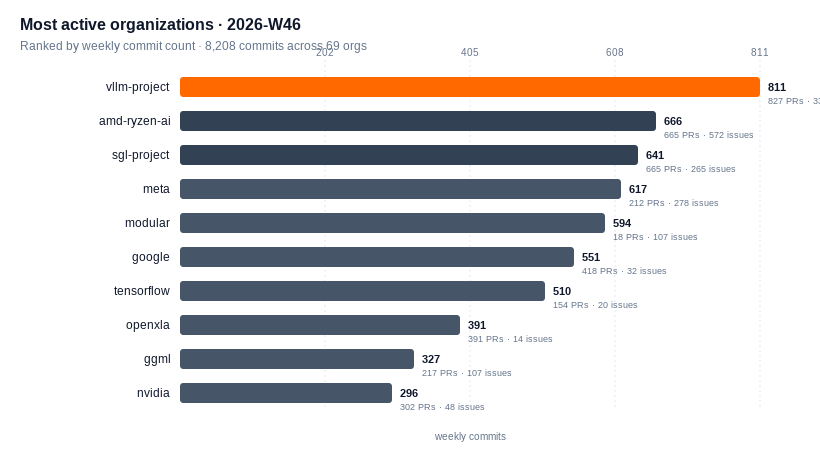
The hottest repos by visible activity were vLLM, SGLang, ggml, Google AI Edge, TensorFlow, ROCm, Open WebUI, and Modular, each with hundreds of commits, PRs, or issues in the supplied window (vLLM, SGLang, TensorFlow).2 Local product repos also showed strong momentum: LocalAI, Open WebUI, Osaurus, Rapid-MLX, oMLX, and Voxt all converted inference plumbing into user-facing workflows (LocalAI, Voxt).4
The most active issue themes were cache correctness, tool-call parsing, low-bit kernel edge cases, platform-specific GPU/NPU failures, and local desktop app reliability (Ollama, FlashInfer, OpenVINO GenAI).56 Contributors also pushed more agent-facing workflows into inference repos, including Triton skills, Open WebUI Tether, LocalAI Sandbox, and Runanywhere Wally contract compatibility (Triton skills, Wally).59
Community Debates
vLLM progress telemetry versus API scope: vLLM closed a proposal for per-request prefill progress over gRPC after maintainers judged the change too invasive relative to the value and redirected the work toward narrower progress surfaces (discussion in PR).61 The debate shows that observability is now a product need, but serving projects still resist adding API weight before runner and cache architecture settles.
Dynamo Kubernetes naming contracts: Dynamo closed proposals to silently repair generated Kubernetes service names because maintainers treated generated names as external contracts and preferred rejecting invalid input over rewriting it (Dynamo PR).62 The thread is a useful reminder that serving infrastructure compatibility often depends on boring naming guarantees, not just kernels.
OpenVINO low-bit GPU paths: OpenVINO closed community u2 optimized GPU paths despite claimed Arc speedups, favoring reference support or oneDNN/IMMAD directions instead (OpenVINO PR).63 The tension is common in low-bit inference: a fast specialized path may lose to a maintainable backend strategy.
try-mirai draws a line around decision models: lalamo maintainers explicitly closed decision-model support as out of scope, despite a substantial proposal covering decision readouts, noncausal prompt attention, option controls, and loaders (lalamo PR).64 That stance keeps lalamo focused on model export/runtime plumbing rather than broad task-specific training or decision infrastructure.
Triton HTTP disconnect cancellation stayed unresolved: Triton closed an HTTP disconnect cancellation PR that proposed using libevent watchers to cancel in-flight requests on client disconnects, but the supplied thread does not expose the maintainer rationale (Triton PR).65 The problem remains important for production inference because abandoned requests can still consume GPU time.
Worth Watching
SGLang’s stability-focused release tracker is the clearest signal that one of the fastest-moving serving projects wants to slow down and harden APIs, parser behavior, router fuzzing, Rust frontend paths, and diffusion surfaces (SGLang tracker).31 vLLM’s runner transition will keep forcing downstream plugin work in Gaudi and Omni, especially where HPU, duplex, diffusion, and multimodal paths still carry compatibility debt (vllm-gaudi, vllm-omni).21
Packed quantization is moving toward graph-level standardization through ONNX, but kernel-level support remains fragmented across ONNX Runtime, OpenVINO, FlashInfer, TensorRT, ROCm, and local formats like GGUF (ONNX, ONNX Runtime).22 Apple Silicon local AI is also becoming a product platform: MLX, oMLX, Rapid-MLX, Voxt, Cactus, and Osaurus all now expose higher-level app workflows above Metal and MLX kernels (Rapid-MLX, Osaurus).27
Web inference is gaining real runtime work: WebLLM has open PRs for run-ahead decoding, forward-pass overlap, incremental KV checkpoint streaming, load-time warmup, suffix decoding, and Qwen Omni graph execution (WebLLM queue).67 Mobile and embedded inference should be watched for the same reason, since LiteRT, ExecuTorch, ncnn, sherpa-onnx, and Qualcomm GenieX are all adding the same classes of low-bit, attention, NPU, and deployment fixes that cloud servers are chasing (LiteRT, sherpa-onnx).68
Major Releases
ggml shipped the headline local runtime release with llama.cpp v1.0.0, plus a rapid binary train and whisper.cpp synchronization toward ggml v1.0.0 compatibility. The dominant theme was API stabilization, backend breadth, FP8 KV cache, server hardening, and speech/LLM stack alignment. llama.cpp v1.0.0.1
vLLM shipped v0.34.0, centered on extensible KV cache by default and removal of GPU Model Runner V1. The release forced downstream alignment work in vllm-gaudi and vllm-omni and made MRv2 the center of the org’s serving architecture. vLLM v0.34.0.2
vllm-omni shipped v0.34.0rc1 to align with vLLM v0.34.0, with MRv2 required for generation stages and session-aware duplex routing plus Mooncake caching highlighted. The release marks Omni’s move from feature branch to plugin stack alignment. vllm-omni v0.34.0rc1.21
SGLang Omni shipped a dense Voxt v2.1.0 to v2.1.1 train for Apple Silicon and macOS. The releases brought Meetings, speaker labeling, formatted result cards, streamed transcription and translation cards, and command-line recording transcription. Voxt v2.1.1.55
NVIDIA shipped TensorRT v11.5, TensorRT-Edge-LLM v0.12.0, and TensorRT-LLM v1.4.0rc4. The theme was CUDA 13.5, ONNX support, Jetson Thor, QNX Safety Runtime, CuTe DSL, Blackwell/Rubin, speculative decoding, and MoE serving. TensorRT v11.5.14
FlashInfer shipped v0.7.5 after a release-candidate train. The release focused on sparse MLA decode, MXFP8 output GEMM, Qwen MoE shapes on Rubin, batch-invariant primitives, Blackwell Kimi MegaMoE, and tree-structured speculative verification. FlashInfer v0.7.5.10
ROCm shipped AITER v0.1.29.post1 and ATOM v0.1.10. Both releases focused on AMD GPU LLM serving, gfx942/gfx950 wheels, ROCm 7.x and 10.x builds, FP4/MXFP8, MoE, and distributed KV paths. AITER v0.1.29.post1.11
FlashAttention shipped fa4-v4.0.0.beta40 as a prerelease with FA4/CuTe and FA3 fixes. The release concentrated on page-table edge cases, kv_batch_idx validation, empty KV-cache handling, and CuTe safety. fa4-v4.0.0.beta40.29
Hugging Face shipped diffusers v0.43.0 and transformers v5.23.0. Diffusers focused on new image/video pipelines, attention backends, tensor parallelism, LoRA, and checkpoint saving, while Transformers highlighted new model additions including Inkling2. diffusers v0.43.0.48
TensorFlow shipped v2.22.0-rc1. The release candidate removed TensorBoard from the default install path and removed experimental C filesystem transaction-token APIs, while the repo continued heavy XLA and LiteRT work. TensorFlow v2.22.0-rc1.54
ExecuTorch shipped v1.6.0 with NXP Neutron, beta TensorRT backend, torch-free Python runtime use, LeRobot policy fixes, faster GPU LLM serving, and Python 3.15 plus PyTorch 2.15 support. The release positioned ExecuTorch as a broader portable runtime for edge LLMs and robotics policies. ExecuTorch v1.6.0.18
Open WebUI shipped v0.13.4 with Tether as the headline feature. The release lets users connect local models, OpenAPI/MCP tools, and terminal servers across devices while keeping local addresses hidden. Open WebUI v0.13.4.51
LocalAI shipped v5.0.0 plus a development build. The major release expanded LocalAI into a desktop workspace with Projects, Files, Office documents, Sandbox, sharing, add-ons, remotes, and OpenAI/Anthropic-compatible APIs. LocalAI v5.0.0.4
Apple shipped coreai-torch v0.4.4 and mlx-swift-lm 3.33.0. The releases focused on dependency/runtime sync, Python and NumPy compatibility, model coverage, and MLX Swift dependency alignment. mlx-swift-lm 3.33.0.25
oMLX shipped v0.8.0 after a release candidate. The release emphasized Prefill Accelerator support, oQh low-bit quantization, and faster DeepSeek and Qwen long-context decode on Apple Silicon and helper setups. oMLX v0.8.0.26
Rapid-MLX shipped v1.0.3, v1.0.4, and matching Mac app releases. The release train focused on image generation, local LoRA adapter serving, coding-agent launch fixes, long-context cache-hit latency, and desktop onboarding. Rapid-MLX v1.0.4.27
Osaurus shipped six 1.0.x macOS app releases from 1.0.2 through 1.0.7. The train focused on 1.0 migration, Workflows, Architect, local model UX, privacy filters, iPhone Sync, TTS, and responsiveness fixes. Osaurus 1.0.7.52
BerriAI shipped a large LiteLLM release train across stable, release-candidate, dev, and LTS builds. The main themes were control-plane features, audit and SIEM integrations, customer hierarchy budgeting, router congestion handling, and signed supply-chain artifacts. LiteLLM v1.110.0.69
AMD Ryzen AI shipped releases across GAIA, FastFlowLM, and Lemonade. The dominant theme was local AI polish: safer agents, OGA/HiPEP backend work, Ollama compatibility, speculative decoding, image references, and RyzenAI backend updates. GAIA v0.26.0.70
Ray shipped Ray-2.58.2 as a security release responding to the eMudhra intermediate CA compromise. The release updated Docker-image pip, certifi, and uv CA-bundle handling because pip trusts vendored certifi in addition to the system store. Ray-2.58.2.32
DeepSpeed shipped v0.20.0 with ZeRO-3, AffineIR, AutoEP, klxpu CI, offload/master-weight work, and broader distributed checkpoint and training infrastructure updates. The release landed during a week of heavy ZeRO and checkpoint correctness work. DeepSpeed v0.20.0.71
Triton Inference Server shipped v2.75.0 for the 26.11 container train. The week paired the release with ONNX and PyTorch skill onboarding plus signing CI for agent-driven model repository setup. Triton Server v2.75.0.33
Qualcomm shipped GenieX v0.11.0. The release highlighted a Microsoft-signed Hexagon HTP catalog for llama.cpp on Windows on Snapdragon and carried prior Go CLI and QAIRT plugin lifetime fixes. GenieX v0.11.0.17
MLC AI shipped WebLLM v0.2.89. The release added MiniCPM5, SmolLM3, LFM2.5 model records, tokenizer APIs, long-prompt fixes, Chrome extension context handling, and a searchable built-in models page. WebLLM v0.2.89.37
k2-fsa shipped forced-alignment artifacts for sherpa-onnx. The apk-fa and react-fa releases made forced alignment available through Android APKs and static WASM React web apps. apk-fa.68
Neywa Labs shipped mlx-audio v0.6.6, mlx-audio-swift v0.2.0, and mlx-vlm v0.8.0. The releases focused on audio model coverage, Swift/Python audio parity, text normalization, long-text TTS, VLM server cleanup, and multimodal model support. mlx-audio v0.6.6.72
try-mirai shipped uzu 0.7.1 and 0.7.2. The releases followed a large Vulkan backend merge that made Vulkan the non-Apple default and aligned Uzu with lalamo model-format changes. uzu 0.7.2.73
Fluid Inference shipped text-processing-rs v0.3.4. The release added FFI panic safety, small-number options, English ITN fixes, St. handling, and parity improvements later consumed by FluidAudio. text-processing-rs v0.3.4.44
OpenNMT did not publish a release, but CTranslate2 landed release-gate, MPS, T5, CUDA, and packaging fixes during the week. The most impactful work fixed GPT-2 and T5Gemma2 MPS regressions plus T5-family Transformers 5 conversion behavior. CTranslate2 MPS fix.74
JAX shipped jax-v0.12.1. The release added Pallas imports under jax.pallas while preserving the experimental path, plus a with_logs option for grad APIs. JAX v0.12.1.75
Foundry Local shipped cli-preview-0.14.0. The preview added embeddings, local document indexing, semantic search, ranking, and typed-decision models. Foundry Local cli-preview-0.14.0.53
ai-dynamo shipped v1.5.1-kimi-k3-post.1. The snapshot targeted experimental Kimi-K3 serving on Dynamo’s SGLang backend and was explicitly framed as evaluation/testing rather than production. Dynamo v1.5.1-kimi-k3-post.1.76
Picovoice did not ship a release, but picollm merged a Node.js dependency security update for js-yaml through Dependabot. The change hardened the Node binding lockfile rather than changing inference behavior. picollm dependency update.77